 By Kartikey Bhatt
A washbasin may occupy only a small part of the bathroom, but choosing the wrong one can affect the entire space. A large countertop basin can make a compact bathroom feel cramped, while a tiny corner basin may look out of place in a spacious master bathroom. Installation height, storage requirements, cleaning effort and plumbing position are just as important as the shape or colour.
Indian homeowners today have far more options than the traditional pedestal basin. Countertop, wall-mounted, under-counter, semi-recessed and integrated designs are now common in apartments, villas, hotels and commercial washrooms. Each type offers a different balance between appearance, usable counter space, storage and maintenance.
The right washbasin therefore depends on bathroom size, usage, plumbing layout and overall design. Understanding the major types before buying can prevent expensive changes to the countertop, vanity or plumbing later.
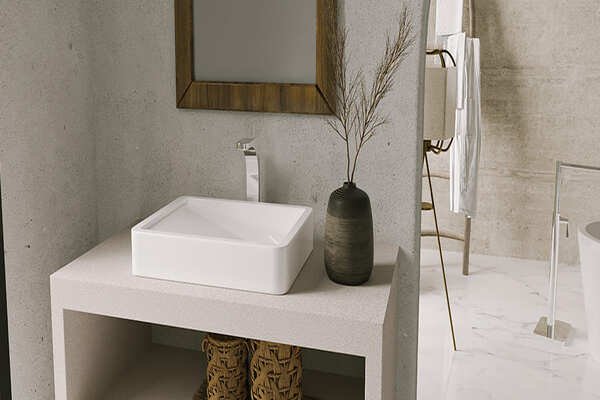
Different Types of Washbasins: Quick Overview
| Washbasin Type | Installation Style | Best Suited For |
|---|---|---|
| Wall-Mounted | Fixed directly to wall | Small bathrooms |
| Pedestal | Basin supported visually by pedestal | Traditional bathrooms |
| Countertop | Basin sits above counter | Modern bathrooms |
| Under-Counter | Installed below countertop | Clean, easy-to-wipe counters |
| Drop-In | Rim rests on countertop | Practical renovations |
| Semi-Recessed | Projects partly beyond vanity | Narrow countertops |
| Corner Basin | Installed in bathroom corner | Very compact spaces |
| Integrated Basin | Basin and counter form one unit | Minimalist interiors |
| Console Basin | Supported by legs/frame | Premium or classic bathrooms |
| Table-Top Bowl Basin | Decorative bowl above counter | Designer bathrooms |
1. Wall-Mounted Washbasin
A wall-mounted basin is attached directly to the bathroom wall without requiring a full vanity cabinet.
It is one of the most practical choices for compact Indian bathrooms because the floor remains visible underneath.
This can make the room appear more spacious and simplifies floor cleaning.
Advantages
- Saves floor space
- Suitable for small bathrooms
- Easy to clean underneath
- Can create a simple, uncluttered appearance
- Installation height can be planned according to user needs
The main disadvantage is limited storage.
Pipework may also remain visible unless concealed or covered appropriately.
The wall must be capable of supporting the basin and mounting system, making correct installation particularly important.
2. Pedestal Washbasin
The pedestal washbasin is one of the most familiar bathroom designs in India.
It consists of a basin with a vertical pedestal extending towards the floor.
The pedestal creates a traditional appearance and helps conceal much of the visible plumbing.
Pedestal basins work well in bathrooms where a vanity cabinet is unnecessary.
Key benefits include:
- Familiar, timeless appearance
- No countertop required
- Plumbing can be visually concealed
- Available in many sizes and designs
However, the pedestal occupies floor space and provides little or no storage.
Cleaning around the base can also require more effort compared with a fully wall-mounted basin.
3. Countertop Washbasin
Countertop basins have become extremely popular in modern Indian bathrooms.
The complete bowl sits above the counter, making the basin a visible design feature.
Shapes range from circular and oval bowls to rectangular and sculptural forms.
Countertop basins are particularly suitable for master bathrooms, powder rooms and premium interiors.
Their main advantage is design impact.
They can be paired with:
- Stone countertops
- Quartz surfaces
- Solid-surface counters
- Suitable vanity tops
However, height planning is essential.
Because the bowl sits above the countertop, installing the counter at a conventional height without considering the basin can make the final rim uncomfortably high.
The combined counter and basin height should be planned before installation.
4. Under-Counter Washbasin
An under-counter basin is installed beneath the countertop.
Instead of seeing a raised rim sitting on the surface, the countertop continues cleanly to the basin opening.
This creates a smooth, sophisticated appearance.
One practical advantage is cleaning.
Water and small debris on the countertop can often be wiped directly towards the basin without being blocked by a raised rim.
Under-counter basins are popular in:
- Premium bathrooms
- Hotel-style bathrooms
- Large vanity units
- Modern apartments
Installation requires a suitable countertop material and precise cutting.
Because the edge of the countertop around the basin remains exposed, materials that handle this type of installation properly should be used.
Professional fabrication is generally important.
5. Drop-In or Self-Rimming Washbasin
A drop-in basin is inserted into a cut-out in the countertop, with its rim remaining visible above the surface.
The rim supports the basin and covers the cut edge.
This makes drop-in designs practical for many renovations.
They are generally less visually minimal than under-counter basins, but they can be straightforward to install and replace.
Advantages include:
- Practical installation
- Wide range of designs
- Suitable for many countertops
- Easier replacement in compatible cut-outs
The visible rim creates an edge where water residue, soap and dirt may accumulate, so regular cleaning is important.
6. Semi-Recessed Washbasin
A semi-recessed basin is partly fitted into the vanity while the front portion projects beyond the countertop.
This design can be particularly useful when the bathroom is narrow and there is insufficient depth for a standard vanity.
You can potentially use a shallower cabinet while still having a comfortably sized basin.
Semi-recessed models can work well in:
- Narrow bathrooms
- Compact apartments
- Guest bathrooms
- Space-conscious vanity designs
Accurate cabinet and countertop planning is essential because the basin must integrate correctly with both.
The projecting section can also be more exposed to accidental impact than a fully recessed design.
7. Corner Washbasin
A corner basin is designed specifically to use a bathroom corner.
It is one of the most space-efficient options for extremely small washrooms.
Corner basins can be useful in:
- Powder rooms
- Small guest toilets
- Office washrooms
- Compact apartment bathrooms
Their biggest advantage is obvious: they use space that might otherwise remain unused.
However, they are generally smaller than standard basins.
This means they may be inconvenient for heavy everyday use where users need significant washing space or countertop storage.
They are best chosen because the layout demands them, not simply for appearance.
8. Integrated Washbasin
An integrated washbasin combines the basin and surrounding counter into a visually continuous unit.
Depending on the product and material, there may be very few joints between the bowl and countertop.
The result is a highly minimalist appearance.
Integrated designs are popular in contemporary interiors because they offer:
- Clean visual lines
- Fewer edges around the basin
- Easy surface wiping
- A coordinated appearance
The disadvantage is repair and replacement flexibility.
With a conventional basin, the bowl may be replaceable independently. With certain integrated systems, damage can affect a much larger section of the installation.
Check repair options before choosing an expensive integrated unit.
9. Console Washbasin
A console basin combines an open appearance with additional structural support.
The basin may be supported by legs, a metal frame or a combination of wall fixing and front supports.
Console designs can create a distinctive classic or luxury appearance.
Some models also provide useful surface area around the bowl.
They can work particularly well in:
- Large bathrooms
- Heritage-inspired interiors
- Luxury powder rooms
- Boutique-style spaces
The open structure means plumbing may remain partially visible, so pipe selection and installation quality become part of the overall appearance.
10. Table-Top Bowl Washbasins
Table-top bowl basins are technically a form of countertop basin, but they deserve special attention because of their popularity in Indian bathroom design.
These are decorative bowls placed fully above the vanity surface.
They may be:
- Round
- Oval
- Square
- Rectangular
- Asymmetrical
Their strong visual presence makes them popular for premium bathrooms.
But practical details should come before appearance.
A very shallow bowl paired with a powerful tap can cause splashing. Similarly, a tall vessel basin may require a wall-mounted or extended-height tap.
The tap and basin must therefore be chosen together.
Ceramic Remains a Popular Washbasin Material
Vitreous china and ceramic-type sanitaryware are widely used because they offer a hard, smooth and relatively easy-to-clean surface.
Modern washbasins may also be available in materials such as:
- Natural stone
- Glass
- Solid surface
- Engineered stone
- Metal
- Other composite materials
Each material has different requirements for cleaning, stain resistance, impact resistance and installation.
For most households, ease of maintenance should carry as much weight as appearance.
How to Choose the Right Washbasin Size
Bathroom size should determine basin size—not showroom appearance.
Before purchasing, measure:
- Available wall width
- Vanity depth
- Distance from toilet and shower
- Door movement
- Walking space
- Tap location
- Drain position
A large basin in a compact bathroom can interfere with movement.
At the same time, choosing an unnecessarily tiny basin for a family bathroom can lead to constant splashing.
Aim for comfortable proportions.
Match the Tap With the Washbasin
Tap compatibility is frequently overlooked.
A countertop bowl may need a tall deck-mounted tap or a wall-mounted fitting.
An under-counter basin can often work with a conventional deck-mounted mixer.
Pay attention to:
- Tap height
- Spout reach
- Water pressure
- Basin depth
- Position where the stream lands
Ideally, water should fall comfortably into the bowl without hitting its edge aggressively.
Correct tap-and-basin pairing can reduce splashing significantly.
Think About Storage Before Choosing the Basin
If bathroom storage is important, a vanity-based basin arrangement may be more useful than a pedestal or simple wall-mounted basin.
A vanity can store:
- Toiletries
- Cleaning products
- Spare towels
- Grooming items
- Bathroom supplies
In compact Indian apartments, this hidden storage can be extremely valuable.
However, plumbing occupies some cabinet space, so the internal arrangement should be planned around drainpipes and water connections.
Cleaning and Maintenance Should Influence Your Decision
Different basin styles create different cleaning requirements.
For example:
- Under-counter designs make countertop wiping convenient.
- Countertop bowls require cleaning around their base.
- Pedestal basins require cleaning around the floor-mounted pedestal.
- Drop-in basins have a visible rim that needs attention.
- Integrated designs minimise joints.
Hard water can leave mineral deposits on almost any basin.
Regular gentle cleaning is generally easier than allowing deposits to accumulate and later using aggressive chemicals.
Which Washbasin Is Best for Your Bathroom?
There is no single washbasin type that suits every Indian home.
For a small bathroom, wall-mounted or corner basins can save valuable space.
For a modern master bathroom, countertop or under-counter designs offer a premium appearance.
For a narrow vanity, a semi-recessed basin can be practical.
For a traditional, straightforward installation, a pedestal basin remains useful.
The best choice balances space, cleaning, storage, tap compatibility and daily usability. A washbasin should complement the bathroom visually, but more importantly, it should remain comfortable every time someone uses it.
FAQs
1. Which washbasin is best for a small Indian bathroom?
A. Wall-mounted and corner basins are particularly useful where floor space is limited. A semi-recessed basin can also work well when you want a vanity but cannot accommodate a deep countertop.
2. Is a countertop washbasin practical for everyday use?
A. Yes, provided its height, depth and tap position are planned correctly. A poorly matched tall tap or shallow bowl can cause splashing, so the basin and tap should be selected together.
3. Which washbasin is easiest to clean?
A. Under-counter and some integrated basins can be convenient because there are fewer raised edges around the countertop. Actual maintenance also depends on basin material, water quality and installation.
4. Should I buy the tap or washbasin first?
A. Ideally, choose them as a coordinated combination. Basin depth, rim height and mounting style determine the appropriate tap height and spout reach. Planning both together reduces the risk of splashing and awkward everyday use.