 By Kartikey Bhatt
Imagine receiving two job offers at the same time. One is from a young startup where the team is small, responsibilities are broad and you may work directly with the founders. The other is from an established corporate company offering a clearly defined role, structured processes and a recognisable name on your CV. Which one should you accept?
This is a real career decision for many professionals and fresh graduates in India, especially in technology, marketing, finance, sales, design and product roles. Startup jobs are often associated with faster learning, broader responsibilities and rapid change. Corporate jobs are generally associated with structured career paths, established systems, specialised roles and greater organisational stability.
However, neither option is automatically better. Startups can range from a five-person company with uncertain funding to a well-funded organisation employing hundreds of people. Corporates also vary enormously in culture, flexibility and growth opportunities.
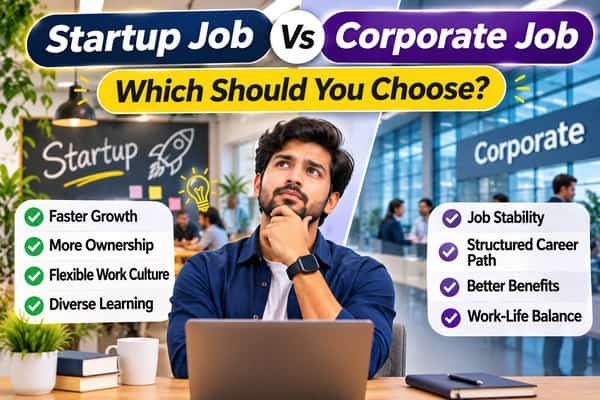
The better choice depends on your career stage, financial responsibilities, learning goals, risk tolerance and preferred working style.
Startup Job Vs Corporate Job: Quick Comparison
| Factor | Startup Job | Corporate Job |
|---|---|---|
| Work Structure | Usually flexible and evolving | Generally structured |
| Responsibilities | Often broad | Usually more specialised |
| Learning | Fast and cross-functional | Structured and role-specific |
| Job Stability | Can be less predictable | Generally more predictable, not guaranteed |
| Decision-Making | Often faster | May involve multiple approval levels |
| Hierarchy | Usually flatter | More defined |
| Processes | Frequently evolving | Established systems |
| Career Path | Can change quickly | Usually more clearly defined |
| Salary | Highly variable | Often more standardised |
| Benefits | Depend heavily on startup stage | Usually more established |
| Equity/ESOPs | May be offered | Less common for many roles |
| Best For | Adaptable, risk-tolerant professionals | Professionals valuing structure and specialisation |
What Is It Like to Work at a Startup?
A startup is generally a young company attempting to develop and scale a business model, although companies continue to be casually called startups even after becoming fairly large.
The working environment can change rapidly.
You may be hired for digital marketing, for example, but find yourself involved in:
- SEO
- Social media
- Customer research
- Analytics
- Product launches
- Website content
- Sales support
This breadth can be extremely educational.
The downside is that responsibilities may not always be clearly defined. Priorities can change quickly depending on customers, competition, funding and business performance.
What Is a Corporate Job Like?
Corporate jobs generally exist within larger, more established organisations with defined departments, reporting structures and operating procedures.
Instead of doing five different marketing activities, you might specialise entirely in performance marketing, SEO, brand management or marketing analytics.
Corporate organisations commonly have formal systems for:
- Recruitment
- Training
- Performance reviews
- Promotions
- Leave
- Compensation
- Compliance
- Reporting
This structure can make expectations clearer.
However, large organisations can also involve more approvals and slower decision-making.
Startups Can Provide Broad Learning
One of the strongest reasons to join a startup is exposure.
A small team cannot always hire a specialist for every task. Employees may therefore work across several areas.
For someone early in their career, this can create a steep learning curve.
You might learn how:
- Products are developed
- Customers are acquired
- Pricing decisions are made
- Marketing campaigns are launched
- Teams are hired
- Investors evaluate businesses
This experience can be especially valuable if you eventually want to start your own company.
However, broad exposure can come at the cost of deep specialisation if you continuously move between unrelated responsibilities.
Corporate Jobs Can Build Deep Specialisation
Large organisations can offer opportunities to become highly skilled in a particular area.
A software developer may spend years working on complex systems at significant scale. A finance professional may gain experience with sophisticated reporting and controls.
Corporates may also provide:
- Formal training
- Experienced managers
- Internal learning programmes
- Established tools
- Mentorship
- Cross-department opportunities
This can help professionals build depth.
The key is ensuring that your role continues to develop rather than becoming repetitive.
Startup Roles Can Change Very Quickly
At a startup, the job description you accepted six months ago may not fully describe what you do today.
The company may launch a new product, enter another market or change strategy.
Employees who enjoy this environment often like solving new problems without waiting for detailed instructions.
A startup may suit you if you are comfortable with:
- Ambiguity
- Experimentation
- Changing priorities
- Learning independently
- Taking ownership
Someone who prefers clearly documented responsibilities may find constant changes frustrating.
Corporate Roles Usually Offer More Defined Responsibilities
Corporates generally divide responsibilities across specialised teams.
For example, a large e-commerce organisation might have separate teams for:
- SEO
- Paid advertising
- Content
- Analytics
- Brand
- Customer retention
This creates clearer accountability.
But it can also mean you have less influence outside your defined area.
Neither system is inherently better. Some people thrive as specialists; others prefer wearing multiple hats.
Job Stability Needs a Balanced View
Corporate jobs are commonly considered more stable.
Large companies may have established revenue, diversified customers and significant financial resources.
Startups can face greater uncertainty due to:
- Limited cash runway
- Dependence on future funding
- Rapidly changing markets
- Unproven business models
- Customer concentration
If funding runs out, hiring freezes or layoffs can occur.
However, corporate employment is not guaranteed either. Large companies can restructure, automate functions, close divisions or reduce their workforce.
Instead of assuming stability based solely on company size, evaluate the actual employer.
Salary Differences Are Not Always Predictable
It is difficult to say that startups or corporates always pay more.
A well-funded startup may offer a highly competitive salary to attract experienced employees.
An early-stage startup may have limited cash and offer lower compensation.
Corporate companies often have established salary bands and structured benefits.
Compare the complete compensation package, including:
- Fixed salary
- Variable pay
- Joining bonus
- Health insurance
- Retirement-related benefits
- Paid leave
- ESOPs or equity, if offered
- Other allowances and benefits
A large headline CTC does not always translate into the highest monthly take-home salary.
Understand every component before accepting an offer.
ESOPs Can Add Opportunity—and Risk
Some startups offer Employee Stock Options (ESOPs) to attract and retain employees.
These can potentially become valuable if the company grows significantly.
But ESOPs should not be treated as guaranteed cash.
Before assigning a value to them, understand:
- Number of options
- Vesting schedule
- Exercise price
- Exercise conditions
- What happens when you resign
- Liquidity possibilities
- Applicable tax implications
A startup saying “you will own part of the company” is not enough information.
Ask for the actual ESOP terms.
Promotions Can Work Differently
A growing startup may create new leadership opportunities rapidly.
Someone who joins a 20-person company could potentially manage a team as the organisation expands.
Promotions may therefore happen quickly.
But startup career paths can also be unpredictable because formal levels may not exist.
Corporate organisations usually have clearer designations and promotion cycles.
Progress may involve moving through defined levels such as:
- Executive
- Senior Executive
- Assistant Manager
- Manager
- Senior Manager
This makes career progression easier to understand, although promotions may take longer.
Work-Life Balance Depends on the Company
There is a stereotype that every startup requires extremely long working hours while corporates provide predictable schedules.
Reality is more nuanced.
Some startups have excellent work cultures. Some large corporations have intense workloads.
Work-life balance depends on:
- Manager
- Team
- Industry
- Role
- Business stage
- Deadlines
- Company culture
Before joining, ask employees about normal working hours rather than relying only on what recruiters say.
Corporate Brand Names Can Help Your CV
Working for a recognised company can provide signalling value.
Recruiters may already understand the organisation’s hiring standards and the scale at which it operates.
This can be particularly useful early in a career.
However, startup experience can also be highly valuable when you can demonstrate measurable impact.
For example:
“Worked at a startup for two years” provides limited information.
But:
“Increased organic leads by 150% while building the SEO function from scratch”
demonstrates actual capability.
Skills and measurable achievements ultimately matter more than company size alone.
Startups May Give You More Visibility
In a small company, your work can be highly visible.
You may interact directly with founders or senior leaders and understand why important business decisions are being made.
This can accelerate commercial learning.
In a large corporation, employees can sometimes feel like one small part of a huge system.
However, corporations may expose employees to projects of a scale that most startups cannot provide.
The type of exposure is different rather than universally better.
What Should Freshers Choose?
Freshers should prioritise learning quality over the startup-versus-corporate label.
Before accepting either offer, ask:
- Who will manage me?
- What will I actually learn?
- Will I receive useful feedback?
- Which tools will I use?
- What will my responsibilities be?
- Can I build valuable skills?
- What have previous employees in this role gone on to do?
A strong manager at a small startup can be better for your career than an uninteresting role at a famous corporation.
The reverse can also be true.
Startup Job Vs Corporate Job: Which Should You Choose?
Consider a startup job if:
- You enjoy fast learning.
- You want broad responsibilities.
- You are comfortable with uncertainty.
- You prefer faster decision-making.
- You want direct exposure to business building.
- You can financially tolerate somewhat higher employment risk.
Consider a corporate job if:
- You prefer structured roles.
- You want specialised experience.
- Formal training matters to you.
- You value established processes and benefits.
- You prefer a clearer career ladder.
- Predictability is an important priority.
The best career decision is rarely based on company type alone. Compare the role, manager, learning opportunity, compensation, company finances, work culture and future career value.
A great startup role can accelerate your career dramatically, while a strong corporate position can provide world-class skills and experience. Choose the environment that best supports what you need to learn and achieve at your current career stage.
FAQs
Q1. Is joining a startup risky for freshers?
A. It can involve greater uncertainty, particularly at very early-stage companies, but risk varies considerably. Before joining, understand the startup’s product, funding situation, business traction, founders, team size and your actual responsibilities.
Q2. Can I move from a startup to a corporate job later?
A. Yes. Startup experience can be valuable to corporate employers, particularly when you can demonstrate strong skills and measurable results. Keep your experience clearly documented rather than relying only on job titles.
Q3. Should I accept a lower salary from a startup for ESOPs?
A. Do not treat ESOPs as guaranteed compensation. Compare the cash salary with your financial needs and evaluate the ESOP terms separately. Understand vesting, exercise price, liquidity and tax implications before assigning them significant value.
Q4. What matters more when choosing a job: salary or learning?
A. Both matter, and the balance depends on your circumstances. Early-career professionals can benefit greatly from strong learning opportunities, but financial responsibilities cannot be ignored. Compare salary alongside skills, manager quality, career progression, stability and future earning potential.