 By Saurav
A beach holiday in India no longer means only walking along the shore, watching the sunset and enjoying seafood. At many popular coastal destinations, the sea has become an adventure zone where travellers can try everything from a short banana-boat ride to scuba diving among coral reefs. Goa’s lively beaches, the clear waters of the Andaman Islands, Karnataka’s coast, Kerala’s tourist beaches and selected destinations in Maharashtra and other coastal states offer a growing variety of water-based experiences.
The right activity, however, depends on much more than excitement. Swimming ability, age, weather, sea conditions, operator quality and safety equipment all matter. Some activities are designed for beginners, while others require professional instruction or certification.
Availability also changes by season. Rough seas, monsoon conditions or local restrictions can temporarily stop activities even at famous beaches. Travellers should therefore treat safety as more important than completing every activity on their holiday checklist.
Popular Water Sports at Indian Beaches: Quick Overview
| Water Sport | Experience | Commonly Found At |
|---|---|---|
| Parasailing | Flying above the sea while towed | Goa and selected tourist beaches |
| Jet Skiing | High-speed motorised ride | Goa, Andaman and other developed beaches |
| Banana Boat | Group inflatable ride | Goa and several tourist beaches |
| Scuba Diving | Underwater marine exploration | Andaman, Goa and selected diving destinations |
| Snorkelling | Surface-level marine viewing | Andaman and clear-water locations |
| Kayaking | Paddling on sea, creeks or mangroves | Goa, Andaman, Kerala and Karnataka |
| Surfing | Riding ocean waves | Tamil Nadu, Karnataka, Kerala and other surf spots |
| Stand-Up Paddleboarding | Standing and paddling on a board | Calm-water tourism destinations |
| Sea Walking | Underwater walking with specialised equipment | Selected Andaman locations |
| Speedboat Ride | Fast recreational boat experience | Many developed tourist beaches |
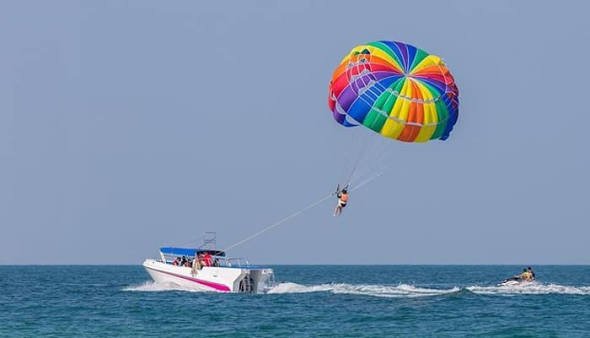
Parasailing: See the Coast From Above
Parasailing is one of the most recognisable beach activities in India.
The participant wears a harness connected to a specially designed parachute-like canopy. A boat provides the towing force, allowing the participant to rise above the water.
The main attraction is the view.
From above, travellers can see the coastline from a completely different perspective.
Parasailing is particularly associated with Goa’s major water-sports zones.
Before participating:
- Use an established operator.
- Check that a proper life jacket and harness are provided.
- Listen carefully to instructions.
- Do not participate during unsuitable wind or weather conditions.
- Tell the operator about relevant health or mobility concerns.
Operations should be stopped when conditions are unsafe, even if tourists are waiting.
Jet Skiing: Popular With Speed Lovers
Jet skiing appeals to travellers who want a faster experience.
Depending on local rules and the operator, tourists may ride with an instructor or be allowed greater control after receiving instructions.
Jet skis can accelerate quickly, so this is not an activity where safety guidance should be ignored.
Check:
- Life jacket fit
- Instructor supervision
- Designated riding area
- Distance from swimmers
- Weather conditions
- Operator procedures
A cheap ride is not a bargain if safety standards are poor.
Popular tourist beaches in Goa and several other coastal destinations commonly advertise jet-ski experiences during suitable seasons.
Banana Boat Rides: A Fun Group Activity
Banana-boat rides are popular with families and groups of friends.
Participants sit on a long inflatable craft that is pulled by a motorboat.
The appeal comes from bouncing across the waves and enjoying the activity together.
Although it may look simple, participants should still wear properly fitted life jackets and follow instructions.
Children should participate only where permitted and under appropriate supervision.
The activity may not be suitable for everyone, particularly people with certain back, neck or mobility problems.
Scuba Diving: Explore Beneath the Surface
Scuba diving offers a completely different experience from high-speed water sports.
Instead of staying above the sea, divers descend underwater using breathing equipment.
The Andaman Islands are among India’s most prominent diving destinations because of their marine environments and coral ecosystems.
Depending on the site and conditions, divers may encounter:
- Coral formations
- Reef fish
- Other marine organisms
- Underwater rock formations
Beginners can participate in introductory diving experiences under professional supervision at appropriate locations, while more advanced dives generally require recognised certification and experience.
Never choose a dive operator solely based on the lowest price.
Professional instruction, equipment quality, emergency procedures and environmental responsibility matter far more.
Snorkelling: An Easier Introduction to Marine Life
Snorkelling allows participants to observe underwater life while remaining near the surface.
Basic equipment generally includes:
- Mask
- Snorkel
- Fins where appropriate
- Flotation equipment when needed
The Andamans are particularly popular for snorkelling because some locations offer relatively clear water and access to marine ecosystems.
However, clear-looking water does not automatically mean safe conditions.
Currents can exist even when the surface appears calm.
Beginners should stay within designated areas and use guided experiences when unfamiliar with the location.
Avoid touching, standing on or breaking coral.
Sea Walking: An Unusual Andaman Experience
Sea walking is available at selected locations in the Andaman Islands.
Participants walk on the seabed while wearing specialised equipment that supplies air from the surface.
It can appeal to travellers who want an underwater experience but are not ready for conventional scuba diving.
Professional supervision is essential.
Suitability can depend on:
- Health
- Age
- Sea conditions
- Operator rules
Travellers should follow medical and safety screening requirements rather than assuming that every underwater activity is suitable for everyone.
Kayaking: A Slower Way to Explore the Water
Not every water sport needs speed.
Kayaking is ideal for travellers who prefer quieter exploration.
Depending on the destination, kayaking may take place along:
- Calm coastal waters
- Creeks
- Backwaters
- Lagoons
- Mangrove environments
Goa, Kerala, Karnataka and the Andamans offer different forms of kayaking experiences.
Mangrove kayaking can be especially interesting because it provides a close view of coastal ecosystems.
Guided trips are sensible for unfamiliar routes.
Even confident swimmers should wear appropriate flotation equipment because currents and weather can change.
Surfing Is Building a Stronger Following in India
India is not traditionally marketed internationally as a major surfing destination, but a growing surfing community has developed along parts of the coastline.
Tamil Nadu has become particularly important, with areas around Kovalam near Chennai and the broader southeastern coast attracting surf enthusiasts.
Surfing is also practised at selected locations in:
- Karnataka
- Kerala
- Goa
- Odisha
Beginners should start with professional lessons rather than renting a board and entering unfamiliar waves alone.
Surfing requires knowledge of:
- Wave behaviour
- Currents
- Board control
- Falling safely
- Surf etiquette
Learning in controlled beginner conditions makes the experience both safer and more enjoyable.
Stand-Up Paddleboarding Is Ideal for Calmer Conditions
Stand-up paddleboarding, commonly called SUP, involves standing on a large board and moving through the water using a paddle.
It is generally more relaxed than surfing and works best in suitable calm-water conditions.
Beginners may spend the first few minutes learning balance, but the basic technique can be approachable with proper instruction.
SUP can be useful for travellers who want:
- Light physical activity
- Coastal scenery
- A slower experience
- Photography opportunities
- An alternative to motorised sports
A personal flotation device and appropriate safety equipment should still be used according to local conditions and operator guidance.
Goa Offers the Widest Mainstream Water-Sports Experience
For first-time travellers looking for multiple activities in one holiday, Goa remains one of India’s most convenient destinations.
Depending on season and beach, travellers may find:
- Parasailing
- Jet skiing
- Banana-boat rides
- Speedboat trips
- Kayaking
- Scuba-diving excursions
- Paddleboarding
North Goa’s popular tourism zones are particularly associated with mainstream recreational water sports.
However, activities can be suspended during the monsoon or whenever sea conditions become unsafe.
Never pressure an operator to continue an activity when weather conditions have deteriorated.
Andaman Is Better Known for Underwater Experiences
While Goa is strongly associated with recreational surface activities, the Andaman Islands are especially attractive for underwater exploration.
Travellers often visit for:
- Scuba diving
- Snorkelling
- Sea walking
- Kayaking
- Boat-based marine experiences
The islands’ coral ecosystems are a major attraction, which also means responsible tourism is essential.
Visitors should never:
- Break coral
- Stand on coral reefs
- Collect living marine organisms
- Throw waste into the sea
- Feed wildlife without appropriate guidance
Enjoying the underwater environment should not involve damaging it.
When Is the Best Time for Water Sports?
Water-sport seasons vary across India’s long coastline.
In many destinations, calmer and drier months are preferred, while the southwest monsoon can bring rough seas to parts of the west coast.
Activities may be temporarily stopped because of:
- High waves
- Strong winds
- Heavy rainfall
- Poor visibility
- Dangerous currents
- Local authority restrictions
This is why travellers should confirm availability shortly before participating rather than assuming an activity operates every day of the year.
How to Choose a Safe Water-Sports Operator
Operator quality can make a major difference.
Before paying, observe how the activity is managed.
Look for:
- Properly fitting life jackets
- Trained instructors
- Equipment in good condition
- Clear safety briefings
- Defined operating zones
- Emergency arrangements
- Compliance with applicable local requirements
Ask what is included in the price before starting.
Clarify whether photographs, transport, equipment or additional activities cost extra.
Most importantly, do not hide a medical condition simply because you do not want to miss an activity.
Who Should Be Extra Careful?
Water sports may not be suitable for everyone.
Extra caution may be necessary for people with certain:
- Heart conditions
- Respiratory problems
- Back or neck problems
- Recent injuries or surgery
- Mobility limitations
- Pregnancy-related considerations
Age, swimming ability and physical fitness can also affect suitability.
Requirements differ between activities and operators, so disclose relevant concerns and follow qualified medical or operator guidance.
Water Sports Can Add Adventure—But the Sea Sets the Rules
India’s coastline offers far more variety than many travellers realise. Goa provides an accessible introduction to mainstream recreational water sports, while the Andamans stand out for underwater experiences. Tamil Nadu and other coastal regions are building surfing communities, and kayaking offers quieter exploration across several states.
The key is choosing activities according to your ability, destination and current sea conditions.
A water sport should be memorable because it was exciting—not because basic safety was ignored.
FAQs
Q1. Can non-swimmers participate in water sports at Indian beaches?
A. Some activities may accept non-swimmers when proper flotation equipment and professional supervision are provided. However, rules vary. Always tell the operator clearly that you cannot swim and never participate if you are uncomfortable with the safety arrangements.
Q2. Which Indian destination is better for scuba diving: Goa or Andaman?
A. Both offer diving opportunities, but the Andaman Islands are particularly well known for marine environments and coral-based underwater experiences. The better choice depends on travel budget, season, experience level and available dive sites.
Q3. Are water sports available in Goa during the monsoon?
A. Availability is often restricted or suspended when sea and weather conditions become unsafe. Exact operations vary by activity and local conditions, so travellers should confirm current availability rather than relying on year-round assumptions.
Q4. Do I need a scuba-diving certificate for my first dive?
A. Many diving centres offer supervised introductory experiences for beginners that do not require a full diving certification. Independent or more advanced dives generally require appropriate training and certification. Always use a reputable professional diving operator.