 By Kartikey Bhatt
A software company selling payroll solutions to Indian businesses and a fashion brand selling sneakers to college students may both advertise online, create social media content and run email campaigns. Yet the way they convince customers to buy is completely different. The software company may spend weeks demonstrating features, answering security questions and negotiating with several decision-makers. The fashion brand may convert a customer within minutes through an attractive product image, a limited-time offer or a recommendation from a creator.
This is the practical difference between B2B (Business-to-Business) and B2C (Business-to-Consumer) marketing. B2B marketing targets organisations buying products or services for business purposes, while B2C marketing primarily targets individual consumers.
The distinction affects much more than the target audience. Buying cycles, messaging, content strategy, advertising channels, sales involvement, pricing and customer relationships can all differ. Businesses that understand these differences can build marketing strategies around how their customers actually make decisions rather than simply copying what works in another market.
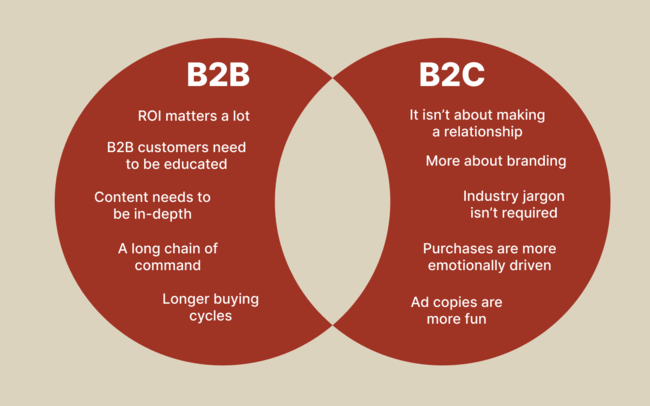
B2B Marketing Vs B2C Marketing: Quick Comparison
| Factor | B2B Marketing | B2C Marketing |
|---|---|---|
| Primary Customer | Businesses and organisations | Individual consumers |
| Decision-Makers | Often multiple people | Usually individual or household |
| Buying Cycle | Often longer | Usually shorter |
| Purchase Value | Frequently higher | Often lower per transaction |
| Main Motivation | Business value, efficiency, ROI, risk reduction | Utility, convenience, price, preference, experience |
| Sales Involvement | Often significant | Usually lower for routine purchases |
| Content | Detailed and educational | Accessible, engaging and product-focused |
| Relationship | Often long-term | Varies from transactional to loyal |
| Pricing | May be customised or negotiated | Usually standardised |
| Common Channels | Search, email, LinkedIn, webinars, events, direct sales | Search, social media, marketplaces, creators, retail |
| Key Goal | Generate and nurture qualified opportunities | Drive awareness, purchases and repeat business |
B2B Marketing Targets Organisational Buyers
B2B companies sell products or services that help another organisation operate, produce, manage, sell or grow.
Examples include businesses providing:
- Accounting software
- Industrial machinery
- Cybersecurity services
- Office equipment
- Logistics solutions
- Business consulting
- Wholesale products
- Cloud technology
- HR software
The person seeing the advertisement may not be the person who makes the final purchase.
For example, an employee may discover a software product, the department head may evaluate it, the IT team may check technical requirements, finance may review the cost, and senior management may approve the purchase.
B2B marketing therefore often needs to convince several stakeholders.
B2C Marketing Speaks Directly to Consumers
B2C businesses primarily market products or services to individuals for personal use.
Examples include:
- Clothing
- Food delivery
- Cosmetics
- Consumer electronics
- Travel
- Footwear
- Home products
- Entertainment subscriptions
The buying process can be much faster.
A consumer may discover a ₹1,500 pair of shoes on Instagram in the afternoon and order it that evening.
This means B2C marketing often needs to create interest quickly while making the purchase process simple.
However, not every consumer decision is impulsive. Cars, expensive electronics, property and other high-value purchases can involve extensive research.
B2B Buying Cycles Are Usually Longer
One of the biggest strategic differences is the time between first contact and purchase.
A business purchasing an expensive technology solution may need to:
- Identify the problem
- Research suppliers
- Request demonstrations
- Compare proposals
- Evaluate features
- Check compliance or security
- Negotiate pricing
- Obtain internal approval
- Finalise the contract
This process can take weeks or months.
Therefore, a B2B marketer cannot judge every campaign by immediate sales.
Marketing must nurture prospects throughout the buying journey.
B2C purchases are often completed more quickly, particularly for low- or medium-value consumer products.
B2B Marketing Focuses Heavily on Business Value
B2B customers usually need a clear commercial reason for making a purchase.
They may ask:
- Will this reduce operating costs?
- Will it save employee time?
- Can it increase revenue?
- Is it reliable?
- Will it integrate with our systems?
- What happens if something goes wrong?
B2B messaging therefore often focuses on measurable business outcomes.
Useful content can include:
- Case studies
- Product demonstrations
- White papers
- ROI calculations
- Comparison guides
- Webinars
- Industry reports
The goal is to reduce uncertainty and demonstrate expertise.
B2C Marketing Often Combines Practical and Emotional Value
Consumers also care about quality and value for money, but personal preferences can play a larger role.
A person buying perfume may care about how it makes them feel. Someone choosing a smartphone may care about design and status as well as specifications.
B2C marketing commonly uses factors such as:
- Convenience
- Lifestyle
- Price
- Design
- Social proof
- Aspirations
- Personal identity
- Offers and urgency
Good consumer marketing rarely depends entirely on emotion, however. Customers still compare prices, reviews, features and alternatives.
The strongest campaigns often combine emotional appeal with practical reasons to buy.
Content Strategy Is Different
B2B customers often need more information before committing.
Suppose a company is considering a ₹10 lakh software contract. A short social media video is unlikely to provide everything decision-makers need.
They may want detailed information about implementation, security, support and expected benefits.
B2B content can therefore be deeper and more educational.
B2C content often needs to communicate value much faster.
Effective formats may include:
- Short videos
- Product photographs
- Customer reviews
- Demonstrations
- Before-and-after content
- Creator collaborations
- User-generated content
The content should match both the complexity and financial significance of the purchase.
Social Media Platforms Serve Different Purposes
Both B2B and B2C companies use social media, but their priorities can differ.
LinkedIn is particularly useful for many B2B businesses because professionals use it for industry networking, recruitment and business information.
B2C companies may place greater emphasis on platforms where visual discovery and consumer engagement are strong.
But platform selection should never rely only on the B2B/B2C label.
A B2B interior-products company, for example, might find visual platforms valuable because architects and designers are part of its audience.
Choose channels based on where actual buyers spend their attention.
Search Marketing Can Work for Both
Google Search can be extremely valuable for both models because it captures existing intent.
A B2B customer may search for:
“payroll software for 100 employees”
while a consumer may search:
“best running shoes under 5000”
Both users have a problem or purchase requirement.
The difference lies in what happens after the click.
A B2C landing page may focus on immediate purchase.
A B2B landing page may encourage the visitor to:
- Request a demo
- Download a guide
- Book a consultation
- Request pricing
- Speak to sales
The conversion goal should match the buying cycle.
B2B Sales and Marketing Need Close Coordination
In many B2B organisations, marketing does not close the final deal.
Marketing generates awareness and leads, while the sales team handles demonstrations, negotiations and contracts.
This makes alignment essential.
Marketing should understand:
- What qualifies as a useful lead
- Which industries convert well
- Common objections
- Average deal size
- Why deals are lost
- How long sales take
Without this feedback, marketing may generate hundreds of leads that sales teams cannot convert.
B2C businesses can often complete the entire transaction through a website, app, marketplace or retail outlet without direct salesperson involvement.
Pricing Strategies Differ
B2C products usually have publicly visible prices.
Customers can compare prices quickly across websites and marketplaces.
B2B pricing may be more complex.
The final price could depend on:
- Number of users
- Order volume
- Contract duration
- Customisation
- Service requirements
- Implementation
- Support level
As a result, B2B marketing often uses “Request a Quote” or “Contact Sales” instead of displaying a single universal price.
Transparent pricing can still work for many B2B products, particularly standardised software subscriptions.
Relationships Often Matter More in B2B
A B2B customer can potentially remain with a supplier for years.
Changing enterprise software, machinery suppliers or logistics partners may involve significant cost and disruption.
This makes customer relationships extremely important.
After-sales support, account management and reliability can directly influence:
- Renewals
- Upselling
- Referrals
- Contract expansion
B2C loyalty also matters, but switching between consumer brands can often be easier.
Therefore, consumer businesses may need to continuously earn attention through product quality, convenience, loyalty programmes and marketing.
Success Metrics Should Reflect the Business Model
B2B marketers should not focus only on website traffic or social-media followers.
Important metrics may include:
- Qualified leads
- Demo requests
- Lead-to-customer conversion
- Sales pipeline value
- Customer acquisition cost
- Sales-cycle length
- Customer lifetime value
B2C marketers may focus more on:
- Conversion rate
- Average order value
- Customer acquisition cost
- Repeat-purchase rate
- Cart abandonment
- Return on advertising spend
- Customer lifetime value
The best metric is the one connected to real business outcomes.
How Should Indian Businesses Choose Their Marketing Strategy?
Start with the customer rather than the channel.
For B2B marketing:
- Identify all important decision-makers.
- Create educational content around business problems.
- Demonstrate measurable value.
- Nurture leads over time.
- Align sales and marketing.
- Build trust through expertise and proof.
For B2C marketing:
- Understand consumer needs and motivations.
- Make product benefits easy to understand.
- Use strong visual and social proof where appropriate.
- Simplify checkout.
- Test offers and creative formats.
- Encourage repeat purchases and loyalty.
Some companies operate in both markets. A laptop manufacturer, for example, may sell directly to individual consumers while also supplying hundreds of devices to corporate customers.
In such cases, separate B2B and B2C marketing journeys are often more effective than trying to communicate with both audiences using identical messages.
FAQs
1. Is B2B marketing more difficult than B2C marketing?
Not necessarily. B2B often involves longer sales cycles and multiple decision-makers, while B2C businesses may face intense competition, high advertising costs and rapidly changing consumer preferences. Each requires a different strategy.
2. Can a B2B company use Instagram and other consumer-focused platforms?
Yes, if its customers or influencers of purchase decisions actively use those platforms. Visual B2B sectors such as architecture, hospitality, design, real estate and food services may find them particularly useful.
3. Which is more important for B2B marketing: leads or website traffic?
Qualified leads and business outcomes are generally more meaningful than traffic alone. Ten visitors with genuine purchase intent can be more valuable than thousands of visitors who are unlikely to become customers.
4. What should a business do if it sells to both companies and consumers?
Create separate customer journeys. Use different landing pages, messages, offers and conversion goals for business buyers and individual consumers. Corporate customers may need quotations and demonstrations, while consumers may expect prices and immediate checkout.
Disclaimer: This article is for general educational purposes. Marketing performance varies by industry, audience, budget, competition, platform and business model. Businesses should test strategies using their own customer and performance data before making significant marketing investments.