 By Saurav
The top cars in India for long-distance driving are the ones that stay calm and comfortable at highway speeds, carry a family and luggage without strain, and go a long way between fuel stops, which points to the Toyota Innova Hycross and Innova Crysta for sheer comfort, the Tata Safari, Mahindra XUV 7XO, and Toyota Fortuner for big-SUV stability, the Maruti Victoris and Grand Vitara strong hybrids for efficiency, and sedans like the Honda City, Hyundai Verna, and Skoda Slavia for composed, quick cruising. A great touring car isn’t just powerful: it has supportive seats, a ride that irons out bad patches, low cabin noise, enough luggage space, driver aids such as cruise control, and strong safety credentials for mile after mile. Prices below are approximate ex-showroom figures from recent listings, and mileage figures are manufacturer claims, so real-world numbers will vary. Confirm current details with a dealer.
What Makes a Car Good for Long Trips
- Comfortable seats and ergonomics: good lumbar support, adjustable steering, and a natural driving position reduce fatigue.
- Ride quality: suspension that absorbs expansion joints and potholes without floatiness or harshness.
- Highway stability and refinement: a planted feel at 100 km/h and above, with low wind and road noise.
- Engine strength: enough power and torque for confident overtaking when loaded.
- Range per tank: a large fuel tank and good mileage cut the number of stops.
- Luggage space: enough room for bags without blocking the rear view.
- Space for all passengers: adult-friendly rear seats and, for larger families, a usable third row.
- Driver aids: cruise control, and ideally adaptive cruise and lane assist, make long stretches easier.
- Safety: airbags, stability control, and strong crash-test ratings.
- Running costs and reliability: a strong service network along your routes.
The Ten Cars
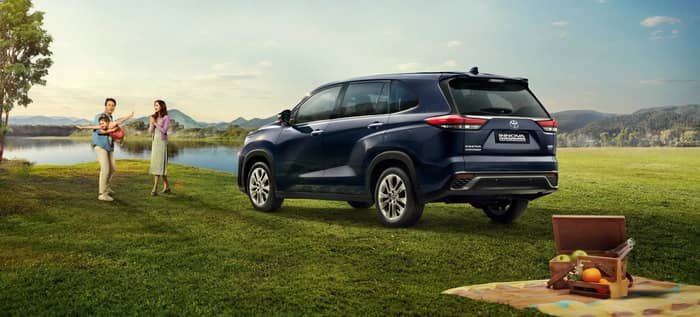
Toyota Innova Hycross (from about ₹19.5 lakh)
- Why it leads: widely regarded as the most comfortable people-mover in India, with adult-friendly seats in every row, a smooth strong-hybrid option claiming about 23 km/l, a 5-star Bharat NCAP rating, and available features like ventilated seats and driver assistance.
- Best for: families on long trips who want comfort above all.
- Keep in mind: the best variants cost considerably more, and boot space with all rows up is limited to about 239 litres.
Toyota Innova Crysta (from about ₹19.7 lakh)
- Why it stands out: the benchmark for dependable highway touring, with a tough diesel engine, a soft, stable ride, strong resale, and seven- or eight-seat layouts.
- Best for: families and professionals who want legendary reliability.
- Keep in mind: an older design with fewer high-tech features, and a diesel mileage of around 11 to 15 km/l in real conditions.
Tata Safari (from about ₹13.3 lakh)
- Why it stands out: a large, stable SUV with a 5-star rating, a comfortable captain-seat option, a strong diesel engine, and a premium cabin, with ADAS on higher variants.
- Best for: families who want a big, safe cruiser.
- Mileage: roughly 14.5 to 16.3 km/l claimed.
- Keep in mind: small boot with all three rows in use.
Mahindra XUV 7XO (from about ₹13.7 lakh)
- Why it stands out: a powerful, feature-packed three-row SUV with strong diesel and petrol engines, a 5-star rating reported, and advanced driver aids on higher trims.
- Best for: buyers who want performance and technology on the highway.
- Mileage: roughly 13 to 16.5 km/l claimed.
Toyota Fortuner (from about ₹34 lakh)
- Why it stands out: a body-on-frame SUV with a commanding stance, 225 mm of ground clearance, a strong diesel engine, and a reputation for toughness on all roads.
- Best for: buyers who want a go-anywhere highway cruiser with excellent dependability.
- Keep in mind: a high price and a firmer ride than car-based SUVs.
Maruti Suzuki Victoris strong hybrid (from about ₹10.5 lakh for the range; hybrids higher)
- Why it stands out: the most efficient SUV on the list at a claimed 28.65 km/l, with a roomy cabin, a top safety record, and a real-world tank range that can approach 900 km or more.
- Best for: high-mileage drivers who want low fuel costs and a comfortable SUV.
- Keep in mind: hybrids give their biggest savings in mixed or city driving, with a smaller edge at steady highway speeds.
Maruti Suzuki Grand Vitara and Toyota Urban Cruiser Hyryder strong hybrids (claimed about 27.97 km/l; hybrids from about ₹16.6 lakh)
- Why they stand out: comfortable mid-size SUVs with an efficient hybrid system, long range per tank, and strong reliability.
- Best for: families who want comfort and efficiency without a big diesel.
Hyundai Creta (from about ₹10.7 lakh; diesel and turbo-petrol versions)
- Why it stands out: a refined, stable SUV with a comfortable ride, a big 433-litre boot, a diesel claiming 18 to 22 km/l, and a 5-star Bharat NCAP rating reported.
- Best for: small families who want a versatile all-rounder.
Honda City and Hyundai Verna (sedans, from about ₹11 to 11.8 lakh)
- Why they stand out: low, stable sedans with good highway manners, large boots (City 506 litres, Verna 528 litres), comfortable rear seats, and driver aids on higher trims. The City e:HEV claims over 26 km/l.
- Best for: couples and small families who prefer a sedan’s stability and efficiency.
Skoda Slavia and Volkswagen Virtus (from about ₹10.3 to 11.6 lakh; 1.5 TSI recommended)
- Why they stand out: European-feeling sedans with an engaging, stable driving experience, a punchy 1.5-litre turbo option, 521-litre boots, and 5-star Global NCAP ratings.
- Best for: drivers who love covering miles in a planted, fun-to-drive car.
Also Worth Considering
- Mahindra Scorpio-N: a rugged SUV with strong diesel torque for highways and rough roads.
- Kia Seltos and Kia Carens: comfortable, well-equipped options with diesel choices.
- Honda Elevate: a spacious SUV with high ground clearance and ADAS on top trims.
- Maruti Invicto: a premium strong-hybrid MPV sharing its base with the Hycross.
- Toyota Camry and larger premium cars: for buyers with bigger budgets who want luxury touring.
Fuel Type: Diesel, Petrol, Hybrid, or Electric?
- Diesel: strong torque for relaxed overtaking and good efficiency on highways, ideal for large SUVs and MPVs.
- Petrol (including turbo-petrol): smoother and quieter, with lower purchase prices, and increasingly capable for touring.
- Strong hybrids: exceptional efficiency and long range per tank, with the most benefit in mixed driving.
- CNG: low running costs, but boot space and station availability can limit long-distance practicality.
- Electric: low running costs, but long trips need charging planning, so check your routes and the charger network.
An illustration with assumed fuel prices (diesel ₹92 per litre, petrol ₹100 per litre) for a 1,000 km trip:
- A diesel SUV at 15 km/l real-world uses about 67 litres, costing roughly ₹6,100.
- A strong hybrid at 22 km/l real-world uses about 45 litres, costing roughly ₹4,500.
- A petrol sedan at 16 km/l real-world uses about 62 litres, costing roughly ₹6,250.
Actual fuel prices and mileage vary, so use your own numbers.
Preparing for a Long Drive
- Service the car beforehand, including oil, brakes, tyres, and coolant.
- Check tyre pressures, including the spare, and adjust for a full load.
- Test the lights, wipers, and horn.
- Carry essentials: a puncture kit or spare, jack, torch, first-aid kit, jumper cables, and a phone charger.
- Plan your route and fuel stops, especially on less-travelled roads.
- Keep a FASTag funded for toll plazas.
- Pack smart: keep heavy items low and centred, and don’t block the rear view.
- Check your documents: licence, registration, insurance, and pollution certificate.
Driving Tips for Comfort and Safety
- Take a break every two hours or about 150 to 200 km, even if you feel fine.
- Avoid driving when drowsy, and share driving if you can.
- Use cruise control on clear stretches to reduce fatigue and save fuel.
- Keep a safe following distance, and be wary of trucks and sudden braking.
- Limit night driving, especially on poorly lit roads.
- Stay hydrated and eat light.
- Respect speed limits and weather conditions.
- Use your seatbelt and secure children in proper car seats.
- Stop safely if you feel unwell, and don’t push on.
What to Check on a Test Drive
- Highway behaviour: stability, steering feel, and noise at 100 km/h.
- Seat comfort over time: adjustable lumbar support, thigh support, and driving position.
- Ride over rough patches.
- Overtaking ability when loaded.
- Rear-seat comfort for the people who will spend hours there.
- Cruise control and driver aids.
- Luggage space with your usual bags.
- Visibility and mirrors.
- Fuel tank size and the real-world range indicated by the display.
Frequently Asked Questions
Q1. Which is the most comfortable car for long drives in India?
A. The Toyota Innova Hycross and Innova Crysta are widely regarded as among the most comfortable options, followed by large SUVs such as the Tata Safari and Toyota Fortuner.
Q2. Which car gives the best mileage for long trips?
A. The Maruti Victoris, Grand Vitara, and Toyota Hyryder strong hybrids claim around 28 km/l, while the Honda City e claims more than 26 km/l.
Q3. Is a diesel or a petrol better for highway driving?
A. Diesel offers strong torque and efficiency for heavy SUVs and MPVs, while modern turbo-petrol and hybrid vehicles are smoother and increasingly efficient. The better choice depends on the specific car and your usage.
Q4. Are sedans good for long-distance driving?
A. Yes. Their low centre of gravity provides excellent stability, and many sedans also offer large boots. However, SUVs generally provide better ground clearance and a higher seating position.
Q5. Can I use an electric car for long trips in India?
A. Yes, it is possible with proper planning. However, charging infrastructure and charging times mean you should map your route and identify suitable charging stops in advance.