 By Kartikey Bhatt
Imagine two businesses trying to find new customers. The first publishes a useful Google article answering a problem its customers regularly search for. A potential buyer discovers the article, visits the website and requests a quotation. The second business creates a targeted advertising campaign and directly places its offer in front of thousands of potential customers. Both have achieved the same objective—generating an opportunity—but through very different marketing approaches.
The first is an example of inbound marketing, where useful content, search visibility and other channels help interested customers discover the business. The second represents outbound marketing, where the business proactively reaches an audience through advertising, direct outreach and similar methods.
For Indian businesses, the question should not simply be which approach is “better.” A startup needing customers this month has different priorities from an established company building organic traffic for the next five years. Understanding how inbound and outbound marketing work can help businesses decide where their marketing budget and effort should go.
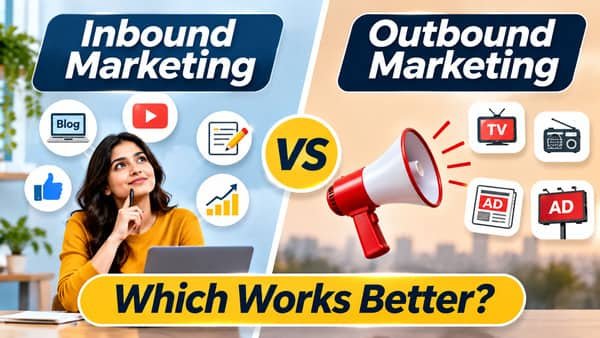
Inbound Marketing Vs Outbound Marketing: Quick Comparison
| Factor | Inbound Marketing | Outbound Marketing |
|---|---|---|
| Basic Approach | Helps customers discover the business | Business proactively reaches prospects |
| Customer Intent | Often higher when search-driven | Varies depending on targeting |
| Common Channels | SEO, blogs, guides, videos, email nurturing | Advertising, cold outreach, direct mail, events |
| Speed | Often slower initially | Can generate visibility quickly |
| Long-Term Value | Content can continue producing results | Usually requires continued campaigns/outreach |
| Targeting | Based on intent, interests and content | Based on selected audiences/prospect lists |
| Lead Education | Strong | Depends on campaign |
| Initial Effort | Significant content and setup | Requires campaign setup, lists, media or sales effort |
| Scalability | Can compound over time | Can scale with budget and outreach capacity |
| Best For | Long-term demand generation | Rapid awareness and proactive prospecting |
What Is Inbound Marketing?
Inbound marketing attracts potential customers by creating useful experiences and information that people actively want to consume.
Instead of interrupting someone with an offer, the business tries to become visible when the customer is researching a problem or solution.
Common inbound methods include:
- Search engine optimisation (SEO)
- Blog articles
- Educational videos
- Guides and e-books
- Webinars
- Case studies
- Organic social media
- Email nurturing
- Useful tools and calculators
Suppose an Indian accounting software company publishes a detailed article titled “How to Create GST Invoices for a Small Business.”
A business owner searching for that information discovers the article through Google. After reading it, the person explores the software and signs up for a trial.
The customer came to the business rather than the business approaching the customer directly.
What Is Outbound Marketing?
Outbound marketing takes the company’s message directly to a selected audience.
Traditional examples include television, radio, newspaper advertisements and direct mail.
Modern outbound marketing can also include:
- Paid digital advertising
- Cold emails
- Cold calls
- Display advertisements
- Sponsored campaigns
- Trade-show outreach
- Direct sales prospecting
The key difference is that the business initiates the interaction.
A customer does not necessarily need to be actively searching for the product when the message reaches them.
That makes outbound particularly useful for generating awareness or reaching prospects who may not yet know they need the solution.
Inbound Marketing Captures Existing Interest
One of inbound marketing’s biggest strengths is its ability to connect with people who already have a problem.
Consider someone searching:
“best CRM software for small business in India”
This person is not randomly browsing. The search itself signals some level of interest.
A CRM provider appearing prominently with a useful comparison or guide has an opportunity to reach the customer at an important point in the buying journey.
This intent can make inbound leads valuable.
However, not every visitor is ready to purchase immediately.
Someone searching “what is CRM?” may only be learning.
Inbound marketing therefore needs content for different stages of the customer journey.
Outbound Marketing Can Create Demand
Customers cannot search for a solution they do not know exists.
This is where outbound marketing becomes powerful.
Imagine a company launches an entirely new productivity tool. Very few people may search for the brand because nobody knows about it yet.
Targeted advertising or direct outreach can introduce the product to potential customers.
Outbound marketing can therefore help businesses:
- Launch new products
- Enter new markets
- Build brand awareness
- Reach specific companies
- Promote limited-time offers
- Generate sales conversations
Instead of waiting for demand, the business actively tries to create it.
Outbound Usually Produces Faster Visibility
SEO and content marketing can take time.
A new website may publish excellent articles but still need months to establish strong organic visibility.
Outbound campaigns can begin producing impressions almost immediately after launch.
For example, an Indian D2C brand launching a festive collection cannot necessarily wait six months for SEO rankings.
Paid advertising can put the products in front of customers during the relevant shopping period.
Speed is one of outbound marketing’s strongest advantages.
However, faster visibility does not guarantee profitability. Campaigns still need effective targeting, messaging, landing pages and economics.
Inbound Can Create Compounding Value
A useful article published today can potentially continue attracting visitors months or even years later if it remains relevant and maintains search visibility.
Similarly, a high-quality YouTube tutorial can continue generating views long after publication.
This gives inbound marketing an important characteristic: content can become a long-term business asset.
A growing library of useful content can build:
- Organic traffic
- Brand authority
- Customer trust
- Email subscribers
- Leads
- Sales opportunities
However, inbound is not truly free.
Businesses still invest in writers, designers, SEO, video production, technology and content updates.
The cost is simply structured differently from paying directly for every advertising impression or click.
Outbound Results Often Depend on Continued Spending
Suppose a business generates 500 website visits daily through paid advertising.
If the campaign stops, a large portion of that traffic may disappear immediately.
This differs from established organic search traffic, which may continue even when daily advertising expenditure stops.
However, outbound’s direct relationship with spending can also be an advantage.
If a campaign is profitable, the company may increase the budget and generate more opportunities relatively quickly.
This makes paid outbound channels easier to scale in some businesses.
Lead Quality Depends on Targeting and Intent
It is tempting to claim that inbound always generates better leads.
Reality is more complicated.
Inbound can generate high-intent prospects, but it can also attract:
- Students
- Competitors
- Researchers
- Job seekers
- People outside the target market
Outbound can reach highly relevant prospects when targeting is precise.
For example, a B2B company selling expensive industrial equipment may build a list of 100 factories that perfectly match its ideal customer profile.
Direct outreach to those companies may be more valuable than attracting 20,000 general website visitors.
Lead quality depends on relevance, intent and qualification, not simply whether the source is inbound or outbound.
Trust Is Often Built Naturally Through Inbound Content
Educational content gives customers an opportunity to evaluate a company before speaking with sales.
A potential client might read three articles, watch a webinar and download a guide before requesting a consultation.
By that stage, the business has already demonstrated expertise.
This is particularly valuable for high-consideration services such as:
- B2B software
- Consulting
- Financial services
- Professional services
- Education
- Enterprise technology
Good inbound content answers questions before the customer needs to ask a salesperson.
Outbound Requires Careful Messaging
Outbound communication arrives without the customer necessarily requesting it.
This makes relevance extremely important.
A generic cold message sent to thousands of people may produce poor results and damage brand perception.
Effective outbound communication should clearly answer:
- Why are you contacting this person?
- What problem can you solve?
- Why is your offer relevant?
- What should the recipient do next?
Businesses must also respect applicable privacy, telecommunications, advertising and anti-spam requirements when conducting outreach.
Personalisation should make communication more useful—not intrusive.
Measuring Performance Is Essential for Both
Inbound marketers should monitor metrics such as:
- Organic traffic
- Search visibility
- Lead conversion rate
- Content-assisted conversions
- Customer acquisition cost
- Qualified leads
- Revenue generated
Outbound marketers may track:
- Advertising impressions
- Click-through rate
- Cost per lead
- Response rate
- Meeting-booking rate
- Customer acquisition cost
- Return on advertising spend
Avoid focusing on vanity metrics.
An article with 100,000 views is not necessarily successful if it generates no relevant business opportunities.
Similarly, an advertisement receiving thousands of clicks can lose money if visitors never convert.
Which Works Better for Small Businesses in India?
For many small businesses, inbound marketing can be an excellent long-term foundation because useful content and search visibility can gradually reduce dependence on paid customer acquisition.
But relying exclusively on inbound may create slow growth, particularly when the business is new.
Outbound can provide faster market exposure.
A practical small-business strategy might involve:
- Creating a search-friendly website
- Publishing useful content
- Optimising local search visibility
- Running targeted paid campaigns
- Following up with qualified leads
- Building an email database
- Retargeting interested visitors
In this model, outbound produces immediate exposure while inbound builds a longer-term customer acquisition engine.
Inbound Vs Outbound: Which Should You Choose?
Prioritise inbound marketing when:
- Customers actively search for your solution.
- Your product requires education.
- You want to build long-term organic visibility.
- Content can demonstrate expertise.
- You can wait for results to compound.
Prioritise outbound marketing when:
- You need visibility quickly.
- You are launching a new product.
- Customers are not actively searching for your solution.
- You can identify specific target prospects.
- You have a measurable advertising or sales process.
For many businesses, the strongest answer is not inbound versus outbound but inbound plus outbound.
Outbound can generate immediate attention while inbound builds trust and long-term visibility. A potential customer might first discover a company through an advertisement and later read its articles before making a purchase.
The better strategy is the one that reaches the right customer at the right stage while keeping customer acquisition cost commercially sustainable.
FAQs
1. Is inbound marketing cheaper than outbound marketing?
A. Not necessarily. Inbound does not require payment for every organic click, but quality content, SEO, video and marketing technology still cost money. Its advantage is that successful content may continue generating results over a longer period.
2. How long does inbound marketing take to work?
A. There is no fixed timeline. Results depend on competition, website authority, content quality, search demand, distribution and industry. New businesses should generally treat inbound as a medium- to long-term strategy rather than expecting immediate results.
3. Should a new business start with inbound or outbound marketing?
A. A combination can be practical. Outbound campaigns can generate initial visibility and customer feedback, while inbound content gradually builds organic traffic and credibility. The balance should depend on budget and customer behaviour.
4. Can outbound marketing work without cold calling?
A. Yes. Outbound includes many methods beyond cold calls, such as paid advertising, targeted email outreach, sponsorships, direct mail and trade events. Choose channels based on where your target customers can be reached effectively.