 By Kartikey Bhatt
A small business in India rarely has the luxury of wasting its marketing budget. Whether it is a neighbourhood salon in Delhi, a coaching centre in Jaipur, a clothing store in Surat or a home-services company in Bengaluru, every rupee spent on promotion should ideally bring the business closer to potential customers. This creates an important question: Should a small business invest in digital marketing or traditional marketing?
Digital marketing uses online channels such as search engines, social media, websites, email and online advertising. Traditional marketing relies on offline channels such as newspapers, flyers, hoardings, radio, events and local print advertising.
Digital marketing offers powerful targeting, measurable results and the ability to start with relatively modest budgets. Traditional marketing can provide strong local visibility, physical presence and familiarity, especially in markets where offline buying behaviour remains important.
For most small businesses, the smartest strategy is not blindly choosing one over the other. It is understanding where customers spend their time, how they discover businesses and which channels actually produce profitable enquiries or sales.
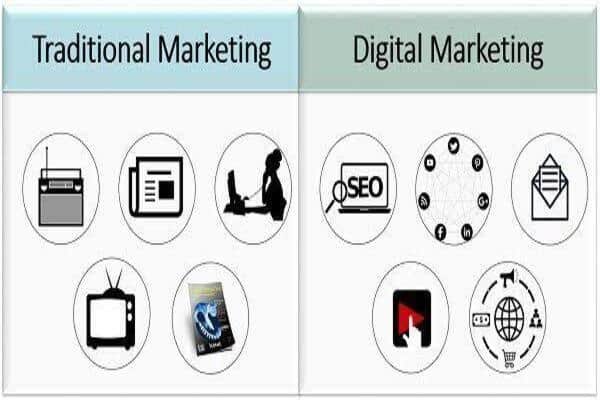
Digital Marketing Vs Traditional Marketing: Quick Comparison
| Factor | Digital Marketing | Traditional Marketing |
|---|---|---|
| Channels | Search, social media, websites, email, online ads | Newspaper, radio, flyers, hoardings, events |
| Targeting | Highly specific in many channels | Usually broader |
| Geographic Reach | Local to global | Often local or regional |
| Starting Budget | Can be relatively flexible | Often requires fixed campaign spending |
| Measurement | Usually detailed | Can be harder to attribute |
| Interaction | Two-way and immediate | Mostly one-way |
| Campaign Changes | Often quick | Usually slower after publication |
| Personalisation | Strong possibilities | Limited in mass media |
| Local Visibility | Excellent with local digital strategy | Strong through local offline media |
| Physical Presence | Limited | Strong |
| Best For | Measurable, targeted customer acquisition | Awareness, local reach and offline audiences |
What Is Digital Marketing?
Digital marketing covers promotional activities carried out through internet-connected channels.
For a small Indian business, this can include:
- Google Search visibility
- Search engine optimisation (SEO)
- Social media marketing
- Paid search advertising
- Social media advertising
- Email marketing
- Content marketing
- Video marketing
- Local business listings
- Online marketplace promotion
One of its greatest strengths is flexibility.
A business does not necessarily need a huge national campaign. A local service provider may target people within a particular geographic area rather than paying to reach audiences across India.
This can make digital channels particularly useful for small businesses with limited marketing budgets.
What Is Traditional Marketing?
Traditional marketing refers mainly to offline methods used to reach potential customers.
Common examples include:
- Newspaper advertisements
- Magazines
- Flyers
- Brochures
- Posters
- Hoardings
- Radio
- Local television
- Trade fairs
- Exhibitions
- Event sponsorships
These methods remain relevant in India.
For example, a property developer launching a local project may benefit from outdoor advertising around the target area. A retailer may distribute flyers within nearby residential societies.
Traditional marketing is therefore not “old-fashioned” simply because digital marketing has grown. Its usefulness depends on customer behaviour and campaign objectives.
Digital Marketing Offers More Precise Targeting
Traditional advertising often reaches a broad audience.
If a local gym places an advertisement in a newspaper, thousands of readers may see it, but many may live too far away or have no interest in joining a gym.
Digital advertising can potentially narrow the audience using factors such as:
- Location
- Interests
- Search intent
- Demographic characteristics where permitted
- Previous website interactions
- Online behaviour signals available to the platform
This can reduce wasted exposure.
However, precise targeting does not automatically produce good results. The advertisement, offer and landing page must still persuade the customer.
Traditional Marketing Can Create Strong Local Visibility
Imagine a newly opened restaurant on a busy road.
A well-positioned signboard or outdoor advertisement nearby can repeatedly expose commuters and residents to the restaurant’s name.
This physical visibility can be difficult to replicate entirely online.
Traditional channels can work particularly well for businesses such as:
- Restaurants
- Retail stores
- Real estate
- Local education institutes
- Hospitals and clinics
- Home-improvement businesses
- Events
The key is geographic relevance.
A local business usually benefits more from reaching 10,000 people living nearby than one lakh people scattered across unrelated locations.
Digital Marketing Is Easier to Measure
Measurement is one of digital marketing’s biggest advantages.
A business can often track metrics such as:
- Website visits
- Advertisement clicks
- Calls
- Form submissions
- Online purchases
- Cost per lead
- Conversion rate
- Customer acquisition cost
- Advertising return
Suppose a small business spends ₹20,000 on an online campaign and generates 80 enquiries.
It can calculate the approximate cost per enquiry and then determine how many enquiries became paying customers.
Traditional campaigns can be more difficult to attribute.
If someone sees a newspaper advertisement and visits the store three days later, the business may not know exactly which advertisement influenced the visit.
Special coupon codes, dedicated phone numbers or customer surveys can improve offline measurement.
Digital Campaigns Can Be Changed Quickly
Suppose an online advertisement is receiving clicks but no sales.
The business can potentially:
- Change the headline
- Replace the image
- Modify targeting
- Adjust the budget
- Change the landing page
- Pause the campaign
This flexibility allows businesses to test and learn quickly.
Traditional advertising is generally less flexible once published.
If 10,000 brochures have already been printed with the wrong price, correcting them can be expensive.
Similarly, a newspaper advertisement cannot be edited after publication.
For small businesses that frequently change products, offers or prices, digital marketing provides a practical advantage.
Traditional Marketing Can Feel More Tangible
Physical marketing materials can create a different type of customer experience.
A professionally designed brochure for an interior-design firm, for example, allows potential clients to physically view project photographs and service information.
Similarly, participating in an exhibition allows customers to meet the business face-to-face.
Traditional marketing can support trust through:
- Physical presence
- Local familiarity
- Personal interaction
- Repeated offline visibility
- Printed materials
This can be especially valuable for high-consideration purchases where customers want direct human interaction.
Digital Marketing Helps Customers Find You When They Need You
Search marketing has a major advantage: customer intent.
Imagine someone searches online for:
“AC repair near me”
The person already has a problem and may be actively looking for a service provider.
A local AC repair business appearing at the right moment has an opportunity to convert that demand into a call or booking.
This differs from advertising to someone who has no immediate requirement.
For small businesses providing services people actively search for, local search visibility can be particularly valuable.
Social Media Can Build Relationships
Digital marketing is not limited to advertisements.
Social media gives businesses an opportunity to communicate directly with customers.
A bakery can share new cake designs. A salon can demonstrate hairstyles. A clothing brand can showcase new arrivals. A dentist can publish educational oral-care content.
Customers can:
- Comment
- Ask questions
- Share posts
- Send messages
- Leave feedback
This two-way interaction can help businesses build familiarity over time.
However, followers and likes should not become the only goal.
Social activity should ultimately support awareness, enquiries, customer relationships or sales.
Traditional Marketing Can Reach Less-Digital Audiences
India has a massive online population, but customer behaviour still varies significantly by age, location, profession and income group.
Some audiences may respond strongly to:
- Local newspapers
- Community events
- Outdoor advertising
- Flyers
- Radio
- Local sponsorships
A business targeting a particular neighbourhood or demographic should study how those customers actually consume information rather than assuming everyone behaves digitally.
Marketing decisions should be based on customer behaviour, not trends alone.
Which Is More Cost-Effective?
There is no universal winner.
Digital marketing can be highly cost-effective because businesses can start with controlled budgets and target specific audiences.
But competitive online advertising can become expensive.
Traditional marketing can also provide excellent value when the audience is concentrated geographically.
Instead of asking which channel is cheapest, calculate:
Marketing cost ÷ customers acquired = customer acquisition cost
Then compare the revenue and profit generated by those customers.
A ₹50,000 campaign producing ₹3 lakh in profitable sales may be better than a ₹10,000 campaign producing almost nothing.
A Combined Strategy Often Works Best
Small businesses do not have to choose exclusively between online and offline marketing.
Consider a local furniture showroom.
Traditional marketing could include:
- Attractive storefront signage
- Local flyers
- Participation in home exhibitions
Digital marketing could include:
- Local search optimisation
- Google advertising
- Instagram product videos
- Customer reviews
- Retargeting advertisements
A customer might first see the showroom’s outdoor advertisement, search for it online, read reviews and then visit the store.
In this case, traditional marketing creates awareness while digital marketing helps complete the customer’s research journey.
Which Marketing Approach Should Your Small Business Choose?
Prioritise digital marketing when:
- Customers actively search online for your services.
- You need detailed campaign measurement.
- Your audience can be targeted accurately.
- Online enquiries or sales are important.
- You want flexibility to test campaigns.
Consider traditional marketing when:
- Your customers are concentrated in a local area.
- Physical visibility is important.
- Offline events influence buying decisions.
- Your target audience regularly consumes local offline media.
- Face-to-face interaction supports sales.
For many Indian small businesses, the most effective approach is a carefully measured combination. Use digital channels for targeting, search visibility and tracking while using selected traditional channels to strengthen local awareness and credibility.
The real objective is not to become a “digital” or “traditional” marketer. It is to invest in channels that consistently reach the right customers at a sustainable acquisition cost.
FAQs
1. Is digital marketing always cheaper than traditional marketing?
A. No. Digital campaigns can start with smaller budgets, but costs may rise in competitive industries. Cost-effectiveness should be judged by leads, customers and profit generated rather than campaign price alone.
2. Which digital marketing channel should a local business start with?
A. It depends on customer behaviour. Businesses that customers actively search for can prioritise local search visibility, while visually driven businesses may benefit from social media. Start with one or two relevant channels rather than trying everything simultaneously.
3. How can I measure whether newspaper or flyer advertising works?
A. Use a dedicated phone number, QR code, coupon code, landing page or specific offer. You can also ask new customers how they discovered the business and record the responses consistently.
4. Should a small business stop traditional marketing completely?
A. Not if it is producing profitable customers. Instead of abandoning a channel because it is considered traditional, measure its performance. Keep channels that generate worthwhile returns and reduce spending on those that do not.
Disclaimer: This article is for general educational purposes. Marketing costs and results vary by industry, audience, location, competition and execution. Small businesses should track leads, customer acquisition costs and actual sales before increasing expenditure on any marketing channel.