 By Kartikey Bhatt
A kitchen tap is used for everything from filling a pressure cooker and washing vegetables to cleaning greasy kadais and rinsing a sink after dinner. Because it is used so frequently, choosing a kitchen tap only because it looks stylish in a showroom can become an expensive mistake. A beautiful tall tap may splash water everywhere if paired with a shallow sink, while an advanced pull-out model may perform poorly if your home’s water pressure is unsuitable.
For Indian kitchens, the right tap must balance functionality, durability, water pressure, sink dimensions and maintenance. Water quality also matters. Hard water is common in many areas and can leave mineral deposits on aerators and finishes. Homes supplied by overhead tanks may have different pressure conditions from apartments using central pumps.
Whether you are renovating an entire kitchen or simply replacing an old tap, understanding these practical details can help you choose a fitting that remains convenient long after the new-kitchen excitement disappears.
Kitchen Tap Selection: Quick Overview
| Factor | What to Check |
|---|---|
| Tap Type | Pillar, mixer, wall-mounted, pull-out or pull-down |
| Material | Durable body suitable for regular use |
| Sink Size | Width and depth of sink bowl |
| Spout Height | Enough clearance without excessive splashing |
| Spout Reach | Water should fall comfortably inside the bowl |
| Water Pressure | Match manufacturer’s operating requirements |
| Hot Water | Choose mixer if hot and cold supply is required |
| Water Quality | Consider ease of aerator and nozzle cleaning |
| Installation | Deck-mounted or wall-mounted plumbing |
| Maintenance | Cartridge and spare-part availability |
| Finish | Choose according to cleaning needs and kitchen design |
| Warranty | Check coverage and service availability |
Start With How You Actually Use Your Kitchen
Before comparing designs, think about everyday kitchen activities.
A household that regularly cooks large family meals has different requirements from a compact apartment kitchen used mainly by one or two people.
Ask yourself:
- Do you regularly wash large kadais and pressure cookers?
- Do you need hot water at the sink?
- Do you wash vegetables directly in the sink?
- Is the sink single-bowl or double-bowl?
- Do you need the tap to rotate?
- Would a pull-out spray make cleaning easier?
- Is there enough space above and behind the sink?
Once these questions are answered, choosing a tap becomes much easier.
Choose the Correct Type of Kitchen Tap
Several tap designs are commonly available, and each suits a different installation.
Pillar Tap
A simple pillar tap is useful where only one water supply is required.
It is straightforward and can be suitable for basic kitchens or utility sinks.
Single-Lever Mixer
A single-lever mixer controls hot and cold water through one handle.
It provides convenient temperature adjustment and creates a clean, modern appearance.
Two-Handle Mixer
Separate controls manage hot and cold water.
Some homeowners prefer this arrangement because each supply can be adjusted independently.
Wall-Mounted Tap
A wall-mounted kitchen tap can keep the sink or countertop area relatively uncluttered.
However, the plumbing position must align correctly with the chosen fitting.
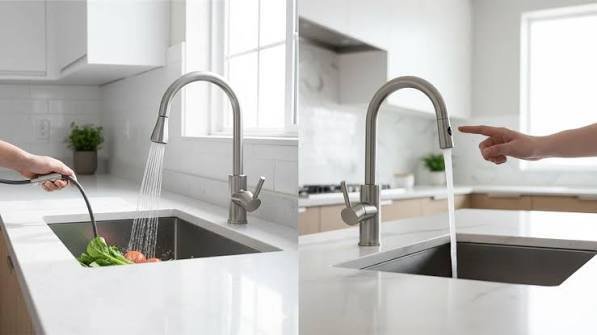
Pull-Out or Pull-Down Tap
These taps include a flexible hose that allows the outlet or spray head to be extended.
They can be extremely useful for rinsing large utensils, washing vegetables and cleaning different areas of the sink.
Match the Tap to the Sink Size
Tap and sink should be selected as a system rather than independently.
A very tall tap over a small, shallow sink can cause excessive splashing.
A short tap over a deep or large sink may make washing bulky cookware uncomfortable.
Pay particular attention to spout reach.
Ideally, the stream should land comfortably inside the sink rather than too close to its rear wall or front edge.
For double-bowl sinks, a swivelling spout can make it easier to direct water into either bowl.
Before buying, measure:
- Sink width
- Sink depth
- Distance from mounting point to bowl
- Available height above sink
- Space behind the tap
A few minutes with a measuring tape can prevent years of inconvenience.
Consider Spout Height Carefully
High-arc taps are popular in modern kitchens because they provide generous space beneath the outlet.
That can be helpful when washing:
- Pressure cookers
- Large pots
- Tall bottles
- Mixing bowls
- Heavy kadais
But higher is not always better.
When water falls from a greater height into a shallow sink, splashing may increase.
Water pressure also affects the result.
A powerful stream from a tall tap can splash onto countertops, walls and clothing.
Choose enough height for your largest everyday utensils without making the tap unnecessarily tall.
Check Your Water Pressure Before Buying
A common mistake is choosing an advanced tap without checking whether the home’s plumbing can support it.
Indian homes may receive water through:
- Overhead gravity tanks
- Municipal supply
- Booster pumps
- Apartment pressure systems
- Combinations of these arrangements
Some modern mixers and spray taps require particular operating-pressure ranges to perform correctly.
A fitting designed for higher pressure may feel weak in a home where the overhead tank provides limited gravity pressure.
Before buying, check the manufacturer’s minimum and maximum pressure specifications.
This becomes especially important for pull-out sprays and other multi-function fittings.
Brass Is a Popular Choice for Permanent Kitchen Taps
Kitchen taps experience frequent use, so body material matters.
Brass is commonly preferred for permanent kitchen installations because it provides good mechanical strength and is suitable for many plumbing applications when properly manufactured.
It also supports a wide range of decorative finishes.
However, “brass body” alone does not guarantee quality.
Check:
- Body construction
- Cartridge quality
- Surface finish
- Internal components
- Warranty
- Manufacturer support
Plastic or engineered-polymer components may also be used in particular parts of modern taps.
What matters is whether each component is suitable for its intended pressure, temperature and mechanical load.
Understand the Importance of the Cartridge
The cartridge is one of the most important components inside many modern taps.
It controls water flow and, in mixer taps, helps regulate the combination of hot and cold water.
A poor-quality cartridge may lead to:
- Dripping
- Stiff handle movement
- Difficulty controlling flow
- Temperature adjustment problems
- Early replacement
When purchasing a kitchen mixer, ask whether replacement cartridges are easily available.
A tap that can be repaired with a readily available component may be far more economical than one that requires complete replacement after a minor internal failure.
Pull-Out Taps Can Be Extremely Useful
A pull-out or pull-down kitchen tap is not just a design feature.
Its flexible hose can make several common kitchen jobs easier.
Potential advantages include:
- Rinsing every corner of the sink
- Cleaning large cookware
- Filling containers beside the sink
- Washing vegetables
- Directing water more precisely
Some models also provide multiple spray patterns.
However, these taps contain more moving components than basic fixed-spout models.
Check the quality of the:
- Flexible hose
- Spray head
- Retraction system
- Connections
- Selector mechanism
Good-quality construction becomes particularly important for a feature used several times every day.
Think About Hard Water Before Choosing a Finish
Hard water can leave white mineral deposits around kitchen taps and aerators.
This can make some finishes require more frequent cleaning.
Chrome remains popular because it is widely available and works with many kitchen styles, but water spots can be visible.
Matte and brushed finishes can provide a different appearance, though their cleaning requirements vary by product.
Whatever finish you choose:
- Follow the manufacturer’s cleaning instructions.
- Avoid harsh abrasive pads.
- Wipe water marks regularly.
- Clean accessible aerators when flow decreases.
- Avoid strong chemicals unless approved for the finish.
Good maintenance can preserve appearance considerably longer.
Hot and Cold Water Requires Proper Mixer Planning
If your kitchen has a geyser or another hot-water source, a mixer tap can make dishwashing more convenient.
But both hot and cold supplies need to be compatible with the fitting.
Large differences in pressure between the two supplies can sometimes make temperature adjustment difficult.
Before installation, confirm:
- Hot-water connection location
- Cold-water connection location
- Heater compatibility
- Pressure conditions
- Maximum temperature rating of the tap
The plumber should understand the complete hot-water arrangement before making final connections.
Swivel Range Matters More Than You Think
A rotating spout is useful, particularly with wide or double-bowl sinks.
But unrestricted rotation is not always desirable.
If a tap can rotate beyond the sink, accidentally turning it too far could direct water onto the countertop.
Check whether the model’s swivel range suits the layout.
For a sink positioned against a wall, a controlled rotation range may be perfectly adequate.
For an island kitchen, requirements may be different.
Do Not Ignore Installation Space
Some taps need more clearance than they appear to require.
A lever positioned close to a backsplash may hit the wall before reaching its full movement.
Pull-out taps can also require space beneath the sink for the hose and associated mechanism.
Under-sink storage can interfere with this movement.
Before installation, inspect:
- Backsplash clearance
- Countertop thickness
- Mounting-hole size
- Under-sink space
- Flexible hose routing
- Water-filter connections
This is especially important in compact modular kitchens.
Choose a Tap That Is Easy to Maintain
The most attractive tap in the showroom may not remain attractive after several years of Indian cooking and hard-water exposure.
Practical maintenance should therefore be part of your buying decision.
Look for:
- Removable or cleanable aerator
- Accessible cartridge
- Available spare parts
- Easy-to-clean surface
- Reliable flexible hoses
- Manufacturer service support
If a minor component fails after three years, being able to replace that component rather than the entire tap is a major advantage.
Common Kitchen Tap Buying Mistakes
Avoid choosing a kitchen tap based only on design or discount.
Common mistakes include:
- Buying without measuring the sink
- Ignoring water pressure requirements
- Choosing an excessively tall spout
- Forgetting backsplash clearance
- Selecting a fixed tap for a large double sink
- Ignoring hard-water maintenance
- Buying a mixer without planning hot-water connections
- Choosing a product with unavailable spare parts
- Prioritising appearance over internal quality
A kitchen tap should make everyday work easier, not simply look impressive in photographs.
The best choice is one that matches your sink, plumbing system, cooking habits and maintenance expectations. When these factors are considered together, even a relatively simple tap can provide better everyday performance than an expensive model that is poorly matched to the kitchen.
FAQs
Q1. Which type of tap is best for an Indian kitchen?
A. There is no single best design. A swivelling single-lever mixer is convenient where hot and cold water are available, while a good fixed or pillar tap can be sufficient for simpler cold-water installations. Large sinks may particularly benefit from pull-out or rotating designs.
Q2. Is a pull-out kitchen tap worth buying?
A. It can be very useful if you regularly clean large utensils, rinse vegetables or need to wash different parts of a large sink. Choose a good-quality model because the hose and retraction mechanism experience frequent movement.
Q3. Why does my tall kitchen tap splash so much?
A. The tap may be too high for the sink depth, the stream may be landing at an unsuitable point, or water pressure may be excessive. Matching spout height and reach to the sink is important for reducing splashing.
Q4. What should I check before replacing my existing kitchen tap?
A. Measure the mounting arrangement, sink dimensions, spout reach, available height and backsplash clearance. Also confirm water pressure, hot/cold connections and under-sink space before purchasing the replacement.