 By Akash Sharma
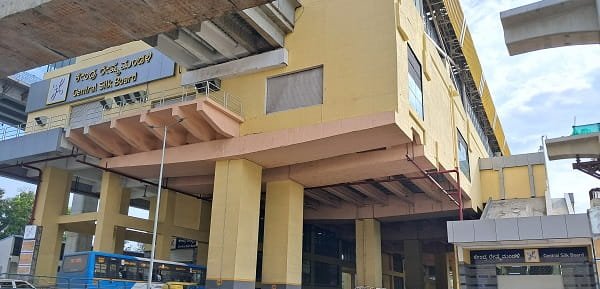
 Central Silk Board Metro Station, commonly referred to as Silk Board Metro Station, is a prominent elevated station on the Yellow Line of Namma Metro in Bengaluru. Situated at one of the city’s most notorious traffic junctions, it has quickly become a vital transit hub since its inauguration on 10 August 2025. The station serves the bustling South Bengaluru area, connecting major residential localities like BTM Layout, HSR Layout, and Bommanahalli with the Electronic City IT corridor. It plays a crucial role in easing congestion at the Silk Board Junction, where Hosur Road meets the Outer Ring Road, and is poised to become an important interchange once the Blue Line becomes operational.
Location
Central Silk Board Metro Station is located on Outer Ring Road, Central Silk Board Colony, Stage 2, BTM Layout, Bengaluru, Karnataka 560068. The elevated structure stands prominently at the confluence of the Outer Ring Road and Hosur Road, overlooking the busy Silk Board Junction — a landmark known for its heavy traffic and commercial importance.
The station is surrounded by a vibrant mix of residential apartments, IT companies, commercial complexes, hospitals, and educational institutions. It serves key areas including BTM Layout, HSR Layout, Bommanahalli, and parts of Koramangala. The locality reflects Bengaluru’s dynamic growth, with numerous gated communities, co-working spaces, restaurants, and shopping outlets. Its strategic position makes it a natural gateway for commuters traveling between central Bengaluru, southern suburbs, and the Electronic City employment hub. The elevated design helps preserve ground-level space while providing excellent visibility and access in this high-density urban corridor.
Connectivity
Silk Board Metro Station offers excellent multimodal connectivity, addressing long-standing traffic challenges at the junction. It integrates seamlessly with road transport through BMTC buses, with major bus stops located nearby for routes across the city. Auto-rickshaws, taxis, and app-based cab services (Ola, Uber, Rapido) are readily available at the station exits for convenient last-mile connectivity.
The station supports robust feeder services to nearby residential pockets and commercial zones. Park-and-ride facilities, particularly for two-wheelers, encourage commuters to combine personal vehicles with metro travel. As a future interchange, it will connect directly with the Blue Line (Outer Ring Road corridor), significantly enhancing east-west connectivity across Bengaluru. An elevated walkway with a travelator is planned to link the Yellow and Blue Line stations smoothly.
Commuters benefit from quick access to Electronic City, HSR Layout, and central areas via the Yellow Line. The station has already eased pressure on Hosur Road and the Outer Ring Road by providing a reliable public transport option, reducing private vehicle usage, lowering pollution, and improving travel predictability for thousands of daily users, especially IT professionals.
Route and Operations
Central Silk Board Metro Station operates on the Yellow Line (North-South Corridor) of Namma Metro. It is an elevated station with side platforms. Platform 1 serves northbound trains towards Rashtreeya Vidyalaya Road (RV Road), while Platform 2 serves southbound trains towards Delta Electronics Bommasandra.
Neighboring stations:
- Towards RV Road (North): BTM Layout (previous station)
- Towards Bommasandra (South): Bommanahalli (next station)
The Yellow Line spans approximately 19 km with 16 elevated stations, connecting RV Road (interchange with Green Line) to Bommasandra via key areas such as Jayanagar, BTM Layout, Silk Board, Electronic City, and Bommasandra. The full end-to-end journey takes around 35–45 minutes. The station opened on 10 August 2025 as part of the Yellow Line inauguration.
Trains generally operate from around 5:00 AM to 11:00 PM. Peak-hour frequencies are typically 5–8 minutes, with slightly longer intervals during off-peak times. Fares are distance-based, starting from a minimum of ₹10. Short trips cost ₹10–20, while longer journeys across the line range between ₹30–60. Namma Metro smart cards provide convenience, minor discounts, and easy recharges for regular commuters. The elevated route offers scenic views of South Bengaluru’s residential neighborhoods, IT parks, and bustling junctions.
Gates and Access Points
Silk Board Metro Station features multiple entry and exit gates designed for efficient passenger dispersal in this high-traffic commercial-residential area. The station layout supports smooth movement toward different sides of the Outer Ring Road and Hosur Road.
Key gates connect to:
- BTM Layout and nearby residential societies.
- HSR Layout and commercial zones.
- Direct access points toward bus stops, auto stands, and the planned interchange walkway for the Blue Line.
Escalators, staircases, and dedicated elevators link street level to the concourse and platforms. The station is fully Divyang-friendly with ramps, wide automatic gates, tactile flooring, braille signage, and priority services. Wheelchairs are available on request. Clear signage and well-lit pathways help manage heavy footfall, especially during morning and evening rush hours. Future elevated walkways and travelators will further enhance interchange convenience with the upcoming Blue Line station.
Facilities
Central Silk Board Metro Station is equipped with modern, passenger-friendly amenities suited to a busy elevated hub. The three-level design includes street level (entrances/exits), concourse (ticketing and services), and platform level.
Key facilities include:
- Parking: Dedicated two-wheeler parking is available, with limited or planned provisions for four-wheelers. This supports daily commuters and park-and-ride users in the area.
- Accessibility: Fully inclusive with elevators, escalators, ramps, wide gates, tactile paths, and reserved spaces. The station prioritizes ease of movement for differently-abled passengers, senior citizens, and families.
- Ticketing and Services: Token Vending Machines (TVMs), ticket counters, smart card recharge kiosks, and Automatic Fare Collection gates. Digital information boards display real-time train schedules and route guidance.
- Convenience Amenities: Clean restrooms, drinking water facilities, seating areas, first-aid support, and small retail kiosks or vending machines. ATMs are available within or near the station. Nearby food streets and commercial areas offer additional dining options.
- Safety and Support: 24/7 CCTV surveillance, fire safety systems, public announcement systems, security personnel, and regular housekeeping. The station maintains high standards of cleanliness and order.
- Other Features: Air-conditioned concourse areas, good lighting, feeder bus connectivity, and clear wayfinding. Plans for enhanced interchange facilities with the Blue Line will further improve the overall experience.
These facilities cater well to the young, dynamic population of South Bengaluru, including IT professionals and students.
Significance and Impact
Since opening in August 2025, Central Silk Board Metro Station has significantly improved mobility in South Bengaluru. By providing a reliable bypass to the congested Silk Board Junction, it has reduced travel times, lowered private vehicle dependency, and contributed to better air quality along the Outer Ring Road and Hosur Road corridors. The station supports economic activity by making Electronic City and other IT hubs more accessible to talent from across the city.
For residents of BTM Layout, HSR Layout, and nearby areas, it serves as a daily lifeline for commuting to work, education, or shopping. As the Blue Line becomes operational (expected around late 2026), Silk Board will evolve into a major interchange, further strengthening Bengaluru’s integrated transit network and supporting the city’s growth as a global technology and innovation hub.
In conclusion, Central Silk Board Metro Station exemplifies modern urban transit planning with its strategic location at a critical junction, strong multimodal connectivity, efficient Yellow Line operations, accessible gates, and comprehensive facilities. It not only eases daily travel but also contributes to decongesting one of Bengaluru’s most challenging traffic points. Whether you are heading to Electronic City for work, commuting to central Bengaluru, or exploring South Bengaluru neighborhoods, this station delivers speed, comfort, and reliability in the heart of the city’s dynamic southern corridor.
Have you ever considered about including a little bit more than just your articles?
I mean, what you say is fundamental and everything. But think about if you added
some great visuals or videos to give your posts more, “pop”!
Your content is excellent but with images and videos, this website could definitely be one
of the very best in its niche. Wonderful blog!
If some one desires to be updated with latest technologies after that he must be pay a visit this site and be up to date all the time.
Please let me know if you’re looking for a article writer
for your site. You have some really good articles and
I think I would be a good asset. If you ever want to take some of the load off, I’d love to write some articles for
your blog in exchange for a link back to mine. Please blast me an email
if interested. Thank you!
Thanks in support of sharing such a good thought, paragraph is pleasant, thats why i
have read it completely
These are truly great ideas in regarding blogging. You
have touched some nice factors here. Any way keep up wrinting.
Awesome website you have here but I was wondering if you knew of any discussion boards that cover the same topics
discussed here? I’d really like to be a part of online community where I
can get suggestions from other knowledgeable people that share the same interest.
If you have any suggestions, please let me know. Kudos!