 By Saurav
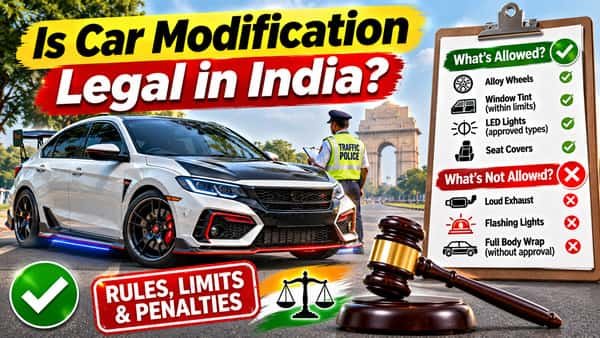
Is car modification legal in India? Partly: cosmetic and approved changes are generally allowed, but anything that alters the specifications on your Registration Certificate, such as the engine, structure, fuel system or dimensions, needs RTO approval under Section 52 of the Motor Vehicles Act, and aftermarket sunroofs, bull bars, loud exhausts and non-compliant window tints are commonly cited as illegal. This is general information, not legal advice, and guides disagree on several points.
Quick Facts
| Modification | Status | Note |
| Alloy wheels and tyres within manufacturer specs | Legal | Oversized wheels and protruding alloys are illegal |
| CNG or LPG kit | Legal with RTO endorsement | Use an ARAI-approved kit and update the RC |
| Colour change | Legal if the RC is updated | Same-colour wraps and clear PPF are generally fine |
| Aftermarket sunroof | Illegal | Alters structure |
| Bull bar | Illegal | Fines of ₹5,000–₹15,000 quoted |
| Engine swap or aftermarket turbo | Illegal without RTO approval | Approval is rare, per one guide |
| Window tint | Disputed | VLT limits quoted; some say any aftermarket tint is illegal |
| Loud exhaust, pressure horns | Illegal | Noise limits apply |
The Short Answer
The test is whether the RC still describes your car.
- Acko says changes that materially affect form or registered specifications, such as chassis, engine or dimensions, are unlawful under Section 52
- One guide quotes a 2019 Supreme Court ruling: “No vehicle shall be modified in a manner that alters its original specifications”
- Cosmetic changes that don’t touch those specifications are mostly safe, but each category has traps
Wheels and Tyres
A common upgrade with a clear boundary.
- Upgrading to alloy wheels or tyres within the manufacturer’s approved size, weight and PCD is generally permitted, according to several guides
- One guide says slight upgrades of one to two inches are fine
- Oversized wheels, or alloys whose lip extends past the tyre edge, are illegal
- Wider tyres are allowed so long as they don’t compromise capacity and meet safety standards, according to InsuranceDekho
Fuel Kits
The clearest “legal with paperwork” case.
- Fitting an aftermarket CNG or LPG kit is legal, but requires registration with the RTO, after which you receive an updated registration certificate
- Converting to CNG or LPG is legal if the kit is ARAI-approved and endorsed on the RC, according to The Auto Technical
- The kit must meet safety and emission standards
Colour, Wraps and Paint
The rule is that the RC colour should match the car.
- A full-body repaint or colour wrap is allowed only if the new colour is updated in the RC through the RTO, according to Carchhe and GoMechanic
- Vinyl wraps that don’t change the registered colour, such as a same-colour wrap, a partial wrap or clear paint protection film, generally need no approval
- Godigit says you don’t need pre- or post-approval from the RTO for a vinyl wrap, which conflicts with the others, so the safe approach is to report a colour-changing wrap
Window Tinting
The most confusing area, because sources disagree.
- Acko, Godigit and Carchhe quote 70% visible light transmission (VLT) for front and rear windscreens and 50% for side windows, based on the 2012 Supreme Court ruling in Avishek Goenka
- VahanBazaar quotes 70% for the front windscreen and front side windows, and 50% for rear side windows and the rear windscreen
- Aftermarket film that maintains those percentages is legal, according to VahanBazaar
- GoMechanic and Creckk say any aftermarket tint is illegal and only factory glass is allowed, and Godigit adds that sunshades on windows are illegal
- Fines are quoted at ₹1,000 to ₹2,500 plus removal, so check with your local traffic police before tinting
Sunroofs, Bull Bars and Body Kits
Structural and safety add-ons draw the most challans.
- Aftermarket sunroof: illegal in every guide I read, since it changes the car’s structure
- Bull bars: illegal, and fitting one attracts challans under Section 190 and Section 52, with fines typically ₹5,000 to ₹15,000 and on-the-spot removal, according to VahanBazaar
- Body kits and spoilers: one 2025 guide says MoRTH lists them as punishable, while GoMechanic says bolt-on body kits are legal, so the answer depends on whether they alter dimensions
- Roof racks and fog lights: described as legal comfort and appearance modifications, according to Acko
Engine and Performance
Anything that changes power is risky.
- Changing engine capacity without RTO approval is illegal
- Engine swaps are allowed with prior RTO permission, according to Creckk, though another guide calls approval very rare
- Aftermarket turbochargers are illegal for private vehicles under Section 52
- ECU remaps may need ARAI or RTO approval, according to Creckk
Exhausts and Horns
Noise rules apply to cars too.
- Loud aftermarket exhausts are illegal, and one guide gives 82 dB as the limit, while motorcycle guides cite 80 dB(A) under CMVR Rule 120(2), so confirm the limit for your vehicle class
- Pressure or musical horns above the rule limits are illegal and can draw fines
- Performance exhausts can bring seizure or removal in some cases
Fines and Penalties
Figures vary across sources.
- Section 52 violations carry fines up to ₹5,000, and ₹10,000 for repeats, according to Acko and CarGraze
- One 2025 guide says fines up to ₹2,000 or RC cancellation, which is lower than the others
- Section 182A is cited for safety and environmental non-compliance, with fines up to ₹10,000 for recurring violations
- Insurance claims can be affected if modifications aren’t declared, so tell your insurer
How to Stay on the Right Side
A short routine helps.
- Check with the RTO before any change to engine, structure, fuel type, colour or dimensions
- Use ARAI- or manufacturer-approved parts and keep the paperwork
- Get the change endorsed on the RC
- Inform your insurer
- Lighting changes follow their own rules, so check them separately
FAQs
Q1. Is car modification legal in India?
A. Car modification is partly legal in India. Minor cosmetic changes may be permitted, but alterations affecting registered particulars, the vehicle’s structure, engine, fuel type, dimensions, or other regulated specifications may require approval and an update to the Registration Certificate (RC) under applicable motor vehicle rules, including Section 52 of the Motor Vehicles Act.
Q2. Is window tinting legal in India?
A. Vehicle glazing must meet the legally prescribed visibility requirements. Rules commonly refer to at least 70% visual light transmission (VLT) for the front and rear windscreens and 50% for side windows. However, aftermarket films have been subject to significant legal restrictions, so factory-compliant glazing should not be confused with adding aftermarket tinting film.
Q3. Can I install an aftermarket sunroof?
A. An aftermarket sunroof can create legal and safety issues when installation involves cutting or altering the vehicle’s original roof or structural design. Such structural modifications should not be treated as automatically legal merely because the accessory is commercially available.
Q4. Is a CNG kit legal in India?
A. CNG conversion can be legal when the vehicle uses an approved and compliant CNG kit, the installation meets applicable requirements, and the fuel-type change is properly recorded with the registering authority. The vehicle’s RC should reflect the approved CNG conversion.
Q5. What is the fine for illegal car modification in India?
A. Penalties depend on the type of modification, applicable provision, and enforcement circumstances. Unauthorised alterations can result in fines and may also require the vehicle to be restored to compliant specifications. Certain prohibited accessories or repeated violations may attract additional enforcement action.