 By Kartikey Bhatt
Replying to office messages during dinner, checking emails before getting out of bed, working on a side project after a full workday and feeling guilty about taking Sunday off—these behaviours are increasingly familiar in modern professional life. In India, where career competition, entrepreneurship, rising living costs and social expectations can create pressure to achieve more, being constantly busy is sometimes treated as proof of ambition.
This mindset is commonly associated with hustle culture. It promotes the idea that professional success requires continuous work, extreme dedication and the willingness to sacrifice comfort or leisure to achieve bigger goals.
Hard work itself is not the problem. Focused effort can help people build businesses, develop skills and improve their careers. The difficulty begins when productivity becomes the main measure of personal worth and rest starts feeling like failure.
Understanding hustle culture is therefore important because its influence extends far beyond office hours. It can affect sleep, exercise, eating habits, relationships, finances and the way people experience everyday life.
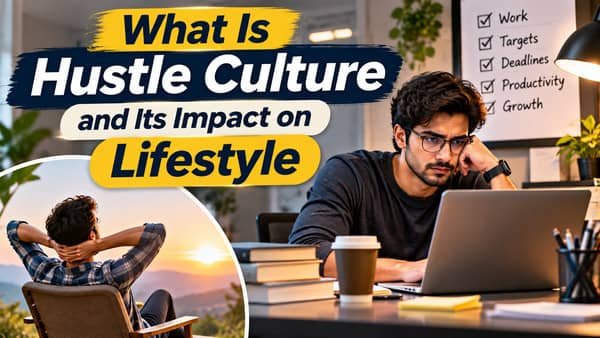
Hustle Culture at a Glance
| Area | Possible Influence |
|---|---|
| Work | Longer hours and constant availability |
| Career | Faster learning but risk of overwork |
| Sleep | Often sacrificed for productivity |
| Physical Health | Less time for movement and recovery |
| Mental Well-Being | Pressure, stress and difficulty switching off |
| Food | Greater dependence on convenience meals |
| Relationships | Less uninterrupted personal time |
| Technology | Constant connection to work |
| Finances | Can increase income but also lifestyle pressure |
| Social Life | Often pushed behind work priorities |
| Rest | May create unnecessary guilt |
| Long-Term Lifestyle | Requires boundaries to remain sustainable |
What Does Hustle Culture Actually Mean?
Hustle culture is a work-focused mindset that strongly values constant productivity, ambition and achievement.
It can encourage behaviours such as:
- Working beyond regular hours
- Maintaining multiple income streams
- Starting side businesses
- Constantly learning professional skills
- Using weekends for work
- Remaining available online
- Measuring progress through output
Some aspects can be positive.
A young professional learning an additional skill after work may improve future career opportunities. An entrepreneur may occasionally need long hours while launching a business.
Hustle culture becomes problematic when temporary periods of intense effort turn into a permanent lifestyle.
Why Has Hustle Culture Become So Popular?
Several social and economic changes have contributed to its popularity.
Social Media Makes Success Highly Visible
People regularly see entrepreneurs, creators and professionals posting about early mornings, long working hours and major achievements.
What viewers rarely see is the complete context behind those results.
This can create the impression that everyone else is progressing faster.
Career Competition Encourages Continuous Improvement
Competitive industries can make professionals feel that existing skills are never enough.
Employees may believe they constantly need another certification, course, side project or professional achievement.
Learning is valuable, but permanent pressure to improve can make it difficult to appreciate existing progress.
Entrepreneurship Celebrates Intense Effort
Starting a business can genuinely require significant effort, particularly during difficult periods.
However, stories of founders working extremely long hours can sometimes turn exhaustion into a symbol of seriousness.
Long hours alone do not create a successful company. Strategy, market demand, financial management, execution and decision-making remain essential.
Technology Has Removed Traditional Work Boundaries
Work once ended more clearly when employees physically left the workplace.
Smartphones changed that.
Emails, workplace chats and video calls can now follow people home.
A message received at 10 PM may not technically require an immediate response, yet employees can still feel pressure to answer.
Remote and hybrid work can make the boundary even less visible because the same room may serve as both office and home.
Useful boundaries may include:
- Setting reasonable communication hours
- Turning off non-essential work notifications
- Keeping some meals work-free
- Separating work and personal devices where practical
- Avoiding unnecessary email checking before sleep
Technology should make work more efficient, not automatically extend the working day.
Hustle Culture Can Disrupt Sleep
Sleep is often one of the first things sacrificed when people want additional working hours.
Someone may work until midnight and still wake early for the next day.
Occasionally doing this during a deadline is different from making it routine.
Repeatedly reducing sleep can affect daytime energy, attention, mood and physical recovery.
It can also create a counterproductive cycle:
Work longer → Sleep less → Concentrate poorly → Take longer to finish work → Work even later
Protecting adequate sleep may therefore improve productivity rather than reduce it.
Exercise Can Become an Optional Activity
When every hour is judged according to professional output, exercise can seem unproductive.
People may repeatedly say:
“I will start after this project.”
Then another deadline arrives.
Physical activity does not need to involve spending two hours at a gym.
Busy professionals can incorporate movement through:
- Walking
- Short strength workouts
- Yoga
- Cycling
- Taking stairs
- Active commuting where practical
- Sports on selected days
A sustainable career should leave enough space to maintain basic physical health.
Eating Habits May Become More Convenience-Based
Long workdays can also influence food choices.
Someone finishing work late may not have the energy to prepare a balanced meal.
As a result, the routine may increasingly depend on:
- Food delivery
- Packaged snacks
- Sugary drinks
- Excessive tea or coffee
- Irregular meals
- Late-night eating
Convenience food is not automatically unhealthy, and ordering meals can be useful during busy periods.
The concern is when workload consistently removes the time and attention needed for regular eating habits.
Simple meal planning and keeping practical food options available can reduce dependence on last-minute choices.
Relationships Can Quietly Lose Priority
Hustle culture does not always damage relationships dramatically.
Often, the change is gradual.
Dinner becomes another opportunity to check email. Weekends become catch-up workdays. Conversations are interrupted by notifications.
Eventually, people may spend time together without giving each other real attention.
Protecting relationships can involve simple habits:
- Keep selected meals phone-free.
- Plan regular time with family.
- Avoid cancelling every social plan for work.
- Take genuine breaks during holidays.
- Be mentally present during conversations.
Career success and meaningful relationships do not need to be opposing goals.
Constant Productivity Can Create Guilt Around Rest
One of the most distinctive features of hustle culture is the feeling that free time should always be converted into productive time.
Watching a film feels wasteful because you could be studying.
Taking an afternoon nap feels lazy because you could be working.
Even hobbies can become projects that need measurable progress.
This removes an important part of life: doing something simply because it is enjoyable.
Rest serves a purpose even when it produces nothing measurable.
Reading, walking, gardening, spending time with friends or simply having an unstructured evening can provide necessary recovery.
Hustle Culture Can Encourage Useful Skills
The discussion should not suggest that ambition is harmful.
Some behaviours associated with hustle culture can be genuinely valuable when used appropriately.
These include:
- Strong work ethic
- Self-discipline
- Continuous learning
- Goal setting
- Entrepreneurship
- Financial ambition
- Time management
The issue is intensity and sustainability.
Working extremely hard for a limited period to launch a product or prepare for an important professional opportunity may be reasonable.
Expecting maximum performance every day for years is different.
More Working Hours Do Not Always Mean More Productivity
Being busy and being productive are not the same.
A person may spend 12 hours at a laptop while constantly switching between meetings, messages and social media.
Another person may complete the important work in seven focused hours.
Better productivity can come from:
- Prioritising high-value tasks
- Reducing unnecessary meetings
- Using focused work periods
- Automating repetitive tasks
- Delegating appropriately
- Taking proper breaks
The objective should be useful output rather than simply accumulating working hours.
A Healthier Alternative Is Sustainable Ambition
People do not need to choose between extreme hustle and having no ambition.
A better approach is sustainable ambition.
It means working seriously towards meaningful goals while protecting the foundations that allow long-term performance.
That can include:
- Working hard when circumstances genuinely require it.
- Maintaining adequate sleep.
- Exercising regularly.
- Protecting important relationships.
- Taking planned breaks.
- Creating realistic financial goals.
- Separating self-worth from professional output.
Different life stages may require different levels of effort. Someone building a new business may temporarily work longer hours than someone in a stable role.
The key question is whether the lifestyle remains manageable.
Recognising When Hustle Has Gone Too Far
Being busy does not automatically mean someone has an unhealthy lifestyle.
However, it may be worth reviewing your routine if work repeatedly causes you to:
- Sacrifice sleep
- Skip meals
- Stop exercising
- Cancel personal plans
- Feel guilty while resting
- Remain mentally connected to work all day
- Ignore hobbies and relationships
- Feel permanently exhausted
The answer is not necessarily to stop working hard.
Sometimes it means changing how work is organised.
Ambition can improve life when it creates opportunities, financial stability and personal growth. But when achievement requires permanently sacrificing sleep, health, relationships and every enjoyable activity, the lifestyle itself may become difficult to sustain.
The goal is not to remove hustle completely. It is to make sure work remains an important part of life without becoming the entire definition of life.
FAQs
1. Is hustle culture always bad?
A. No. Discipline, ambition and temporary periods of intense effort can support career or business goals. Problems arise when excessive work becomes permanent and consistently replaces sleep, health, relationships and recovery.
2. How can I be ambitious without following hustle culture?
A. Set clear priorities, focus on high-value work and create realistic working boundaries. You can continue learning and pursuing ambitious goals while protecting sleep, exercise, relationships and regular recovery time.
3. How do I know whether I am working hard or overworking?
A. Look at the effect of work on the rest of your life. If long hours repeatedly cause exhaustion, poor sleep, missed meals, neglected relationships or difficulty switching off, your routine may need adjustment.
4. Is having a side hustle unhealthy for full-time employees?
A. Not necessarily. A side project can provide additional income, skills or creative satisfaction. The important factors are whether it fits around your primary job, employer policies, health, sleep and personal responsibilities without creating constant exhaustion.